
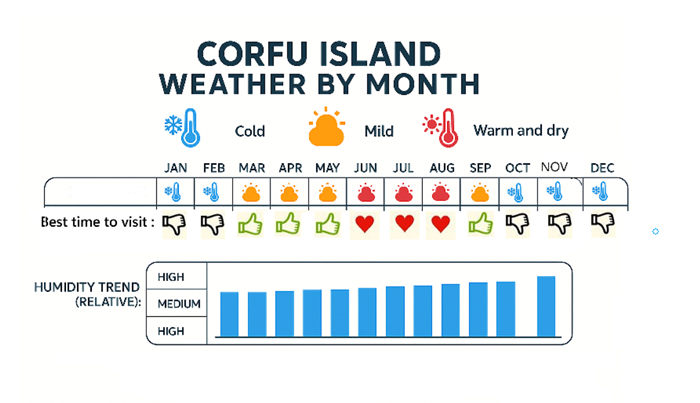
Spring (March – April – May)
May 1st is the official “start” of tourist season, and with good reason. The average temperature in May usually sits around the mid to high 20s, and the sea has warmed up enough to allow for refreshing swimming. Nightly temperatures can often drop to the mid-teens, so be prepared to bring a light jacket if planning to sit outside.
Of special note is that olive pollen is abundant during May, due to the blossoming of the millions of olive trees on the island. If allergies are a problem, don’t plan on visiting in the first two weeks of May. By June, tourist season is in full force, though beaches are not typically overcrowded yet. The average daily temperature ranges from high 20s to low 30s and nightly temperatures at about high teens to low 20s. Rain is very unlikely, but one cloudy day a week can be expected.
Summer (June – July – August)
July is possibly the hottest and busiest month in Corfu. Temperatures are in the mid to high 30s, with nightly temperatures at high 20s. Be sure you show up early at the beach, as they tend to get crowded quickly, as do most of the popular tavernas. Don’t forget to pack plenty of sunscreen—the sun can be unforgiving, and sunburns occur with little exposure. Luckily, the sea water is still refreshing, and you can take a quick dip when you feel the sun is overwhelming.
The weather stays very hot throughout August, with daytime temperatures often breaking the 40-degree mark, and the island maintaining the same traffic as in July. Because of the steady warm weather, sea water is now quite warm, and not as refreshing as in the earlier months. Things tend to cool down in September, both in terms of temperature and travellers. Temperatures drop to high 20s to low 30s, so lying in the sun for longer periods becomes more tolerable than in the blazing August days. As well, the drop in visitors means that beaches and local tavernas will be less busy.
Autumn (September – October – November)
Temperatures remain well in the 20s, even in late October, with water still relatively warm from the sizzling summer months. Beaches are almost deserted, which is good news for someone looking for a very peaceful holiday. Most tavernas are still open, though some may decide to not open evenings, or close on certain days of the week. If you are looking for a quiet holiday, this is definitely the best time of the year to visit. November 1st officially marks the end of the tourist season. Almost all shops, restaurants, and hotels are closed, and all beaches are deserted. Swimming is only for the very brave, as daily temperatures have now dropped to the teens. On the odd day, temperatures may go above 20 degrees, but the sea water is probably too cool to enjoy.
Winter (December – January – February)
Winter temperatures typically stay in the low teens, and generally do not drop below 10 degrees Celsius. More often than not, Corfu is filled with cloudy days, and often several consecutive rainy days. On the occasion that the sun does shine, temperatures can reach the high teens or even low 20s! Beaches are completely deserted, but still look beautiful and peaceful, perfect for long romantic walks with that special someone. Occasionally, villages with high altitude do receive some overnight frost, or even snow, but this typically does not last more than a few hours.
Corfu Climate Overview
This climate overview summarizes Corfu’s typical weather, including monthly averages for temperature, rainfall, and UV index. It highlights both daytime and nighttime temperatures in degrees Celsius along with the expected UV level throughout the year.
-
Mean annual temperature: about 24 °C
-
Peak heat: around 34 °C in July and August
-
Coolest period: roughly 15 °C in January
-
Total yearly rainfall: close to 1,128 mm, averaging 94 mm per month
-
Driest stretch: about 9.4 mm in July, 29 mm in June, and 33 mm in August
-
Rainiest months: near 214 mm in November, 154 mm in January, and 148 mm in December
