Snorkelling & Diving in Corfu: Best Spots & Practical Tips
Corfu is just as beautiful below the surface as it is from the beach. Rocky coves, underwater walls, reefs, caves and exceptionally clear water make several parts of the island excellent for snorkelling and scuba diving.
The experience varies considerably by coast. Paleokastritsa offers some of the island’s most dramatic underwater scenery, while the northeast coast around Nissaki and Kassiopi has rocky coves and generally sheltered places where snorkelling can be easy when conditions are calm.
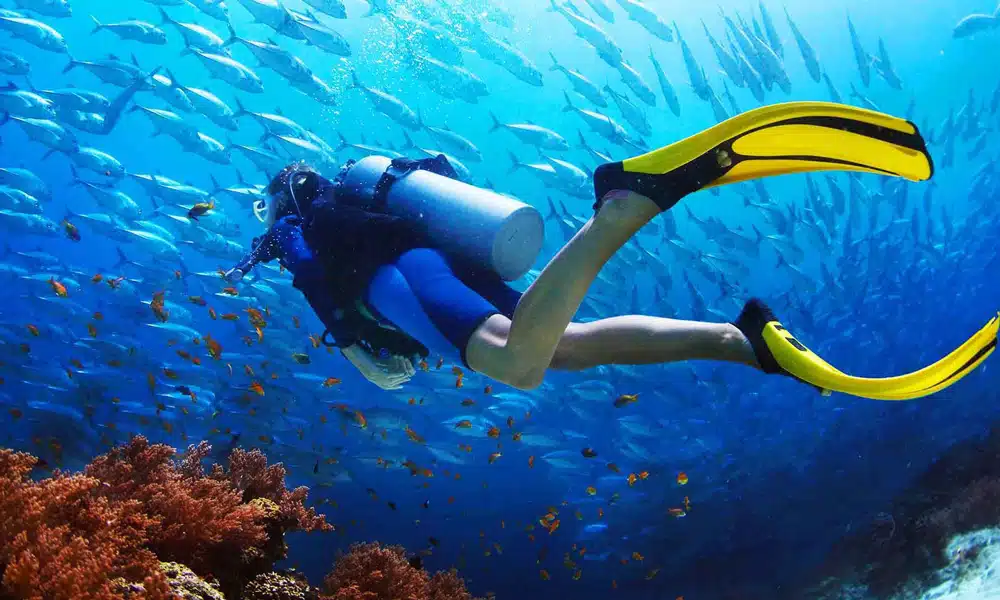
Experienced divers can explore walls, reefs, caverns and wrecks with qualified local dive centres, while complete beginners can book supervised introductory dives without needing previous scuba experience.
Here are some of the best places to start.
Best Snorkelling & Diving Areas in Corfu
• Paleokastritsa: reefs, cliffs, sea caves and some of Corfu’s most established scuba sites
• Nissaki: clear northeast water, rocky seabed and access to organised diving
• Kassiopi: small pebble coves and rocky headlands ideal for snorkelling
• Sidari & Canal d’Amour: unusual sandstone channels for calm-weather snorkelling
• Agios Georgios Pagon: huge bay with rocky areas at its edges
• Liapades: clear coves and easy access to remote beaches by boat
• Barbati & northeast Corfu: clear pebble beaches and rocky shoreline
Paleokastritsa — Corfu’s Most Dramatic Underwater Coast
Paleokastritsa is probably the best-known area in Corfu for combining snorkelling, boat exploration and scuba diving.
The coastline is formed by steep rocky headlands, six main bays and numerous grottoes and caves. The official Visit Corfu guide specifically highlights its rock formations and underwater caves as an important attraction for divers. :contentReference[oaicite:3]{index=3}
For ordinary snorkellers, the best approach is to explore the rocky edges of sheltered bays rather than swimming straight out through areas used by excursion boats.
The water around Paleokastritsa can feel noticeably cooler than on some of Corfu’s eastern beaches, but visibility can be excellent when sea conditions are calm.
Small boats also leave from the local harbours to visit coastal caves and secluded coves.
Best for: Snorkelling, scuba diving, boat trips and underwater scenery
Experience level: Everyone from first-time snorkellers to advanced divers, depending on the specific site
Colovri Reefs — For Certified Divers
One of the best-known dive areas off Paleokastritsa is Colovri.
The reefs around the islet contain dramatic rock formations, underwater walls and deeper sections that descend into the blue.
According to a local diving operator documenting the site, the Colovri Reefs have visibility that can exceed 30 metres, low currents and a maximum recreational dive depth of around 40 metres.
Marine life reported around the reefs includes barracuda, grouper and numerous smaller Mediterranean fish species.
However, this is important: the principal Colovri Reef dive is listed for Advanced Open Water divers. It should not be promoted as a casual beginner dive simply because some surrounding water is shallower.
Qualified dive instructors choose the appropriate site and depth according to certification, experience and current sea conditions.
Caves & Caverns Around Paleokastritsa
Paleokastritsa also has several specialised cavern and cave dives.
These are completely different from looking into a shallow sea cave while snorkelling.
For example, the dive site known as Blue Eye includes a series of underwater caves at relatively shallow depth, but the operator documenting the site requires Advanced Open Water certification and substantial previous diving experience.
The deeper Colovri Cave is even more demanding, with an entrance around 40 metres and specialist experience requirements.
Never enter an underwater cave or enclosed cavern while snorkelling or scuba diving unless the route is appropriate for your training and you are accompanied by a qualified professional.
Snorkelling by Boat in Paleokastritsa
One particularly good option for families is an organised snorkelling boat trip.
Local dive operators run guided excursions that stop at reefs, islets and coastal caves and provide equipment such as masks, snorkels and fins.
This can be easier than trying to identify suitable snorkelling areas yourself, particularly if you have children or limited experience in open water.
Our Corfu boat trips guide has more ideas for exploring the coastline from the sea.
Nissaki — Clear Water on the Northeast Coast
Nissaki is one of the most useful areas for visitors who want both easy snorkelling and access to organised scuba diving.
The coastline is mainly pebbly and rocky, with clear water and underwater structure around the edges of the coves.
Snorkellers should stay close to rocky shoreline areas while remaining aware of boats entering and leaving small harbours.
The Nissaki area is also an established base for diving. Current local operators offer beginner sessions, courses, guided dives and boat diving around the northeast coast, including reefs, walls, caves and wreck sites. :contentReference[oaicite:4]{index=4}
Best for: Beginners, snorkelling and organised scuba trips
My tip: If you are nervous about open-water snorkelling, start inside a protected cove rather than immediately swimming around a headland.
Barbati — Easy Clear-Water Snorkelling
Just south of Nissaki, Barbati has clear water, white pebbles and rocky sections that make it another good choice for casual snorkelling.
The central beach is developed and easy to access, while the edges of the bay are generally more interesting underwater than the open pebble seabed in the middle.
The official Corfu tourism guide also highlights the clarity of the water around Barbati. :contentReference[oaicite:5]{index=5}
Best for: Easy shore access and casual snorkelling
Kassiopi — Small Coves & Rocky Headlands
Kassiopi is one of my favourite areas for simple shore snorkelling because several small beaches sit close together around the headland.
Beaches such as Bataria, Kanoni and Pipitos have pebble entries and rocky margins where there is generally more to see than over a featureless sandy bottom.
The clear water also makes it easier for beginners to become comfortable using a mask.
Stay relatively close to shore and be aware of recreational boats, particularly around the harbour and headlands.
Organised diving trips also operate in the wider Kassiopi and northeast Corfu region.
Best for: Easy snorkelling from several small beaches
Acharavi — Better as a Diving Base Than a Snorkelling Highlight
Acharavi has a long, convenient beach, but I would not rank the central beach itself among Corfu’s most interesting snorkelling locations.
Much of the seabed is relatively open compared with the rocky coves of Paleokastritsa, Nissaki and Kassiopi.
Its main advantage for underwater activities is that established diving operations based in northern Corfu use Acharavi as a base for trips to reefs, walls, caves and wreck sites around the north of the island.
Current operators in the area advertise introductory dives for non-certified visitors as well as dives for experienced and certified divers. :contentReference[oaicite:6]{index=6}
Best for: Staying in North Corfu while joining organised dive trips
Sidari & Canal d’Amour
The sandstone formations of Sidari make Canal d’Amour completely different from Corfu’s rocky northeast coastline.
Narrow channels, caves and small natural pools have been sculpted into the soft sandstone.
The official Visit Corfu guide specifically suggests exploring the caves along Canal d’Amour with a mask. :contentReference[oaicite:7]{index=7}
However, conditions matter enormously.
When the sea is calm, the protected sections can be enjoyable to explore. When wind and swell increase, waves can push swimmers towards rock walls and narrow passages.
Do not enter caves or channels just because somebody else is doing it, and avoid swimming close to cliffs in rough conditions.
Best for: Unusual rock formations when the sea is calm
Not ideal when: There is noticeable swell or strong wind
Agios Georgios Pagon
Agios Georgios Pagon is a huge horseshoe-shaped bay on Corfu’s northwest coast.
The central beach is largely sandy, so snorkellers looking for more underwater life should concentrate on rocky sections towards the edges of the bay rather than swimming over the open sandy centre.
Boat rental is also available locally, making it possible to explore nearby coastline and the area around Porto Timoni when weather and rental restrictions permit. The official tourism guide describes Agios Georgios as a two-kilometre bay and notes the availability of boat rentals. :contentReference[oaicite:8]{index=8}
Best for: Families wanting a large beach with snorkelling as one activity rather than the sole reason to visit
Liapades & the Hidden West-Coast Coves
The coast around Liapades is another excellent area if your idea of snorkelling involves getting away from the main beach.
The local shoreline includes small coves with rocky edges and very clear water, while rental boats provide access to places such as Rovinia and Chomi.
The official Visit Corfu guide confirms boat rentals from Liapades for visiting these nearby coves. :contentReference[oaicite:9]{index=9}
This is a good area to combine snorkelling with a small-boat day rather than remaining on a single beach.
What Marine Life Can You See?
Corfu does not have tropical coral reefs, so expectations should be Mediterranean rather than Caribbean.
Depending on location, season and luck, snorkellers and divers may encounter:
• Small wrasse and other reef fish
• Sea bream
• Damselfish
• Gobies and blennies around rocks
• Octopus
• Moray eels hiding in crevices
• Groupers
• Barracuda, particularly on some deeper dive sites
• Sea urchins and starfish
• Seagrass meadows and associated marine life
The exact marine life varies throughout the year and nothing should be treated as guaranteed.
Snorkelling vs Scuba Diving
If you simply want to put on a mask and explore from the beach, you do not need formal training.
Scuba diving is different.
First-time divers can book supervised introductory or “try dive” experiences with recognised dive centres.
Certified divers can choose from a wider range of reefs, walls, wrecks and deeper sites according to their qualification and experience.
Advanced caves and deeper wrecks may require additional certification, minimum logged dives or specialist training.
Never exaggerate your experience to gain access to a more demanding site. A good dive centre will select the site based on certification, recent diving experience and sea conditions.
Best Time for Snorkelling & Diving in Corfu
The main season runs broadly from late spring through autumn.
Summer brings warmer water, long daylight hours and frequent calm periods, while September and early October can be particularly pleasant because the sea retains summer warmth after the largest crowds have left.
Local diving information reports typical water temperatures of roughly 17°C to 25°C depending on season and conditions, with visibility at selected sites sometimes exceeding 30 metres. :contentReference[oaicite:10]{index=10}
Actual visibility can change from day to day after strong wind, rain or rough seas.
Morning or Afternoon?
There is no rule that every Corfu beach is always calmer in the morning, but early conditions are frequently pleasant during stable summer weather.
More important than the time on the clock is the actual wind and sea state on that particular coast.
Corfu is large enough that the west coast can be rough while the northeast remains relatively protected — or conditions can be reversed by a different wind direction.
Check our Corfu weather information and look at the sea itself before entering.
Snorkelling Safety
• Never snorkel completely alone in a remote location.
• Stay away from harbour entrances and areas with heavy boat traffic.
• Use a highly visible surface buoy if swimming any significant distance from shore.
• Do not enter underwater caves without appropriate training and professional guidance.
• Check sea conditions before entering. Clear water does not mean there is no current or swell.
• Wear water shoes on rocky or pebble entries if necessary.
• Do not touch octopus, moray eels or other marine animals.
• Never stand on or damage seagrass and marine habitats unnecessarily.
• Avoid cliff jumping. Water depth, submerged rocks and swell can be difficult to judge from above.
Boat Traffic Is the Biggest Thing Many Visitors Forget
Some of Corfu’s prettiest snorkelling areas are also popular for rental boats and excursion boats.
This is particularly important around Paleokastritsa, Liapades, Kassiopi and the northeast coast.
Do not swim across an active boat route because the opposite rocks look interesting.
If you plan to snorkel away from shore, use a visible surface marker and choose areas away from harbour entrances and established boat channels.
Respect Corfu’s Underwater Environment
The easiest rule is simple: look, but leave everything where you found it.
Do not remove shells containing living animals, disturb octopus hiding places or chase marine life for photographs.
Avoid dropping anchors into sensitive seagrass whenever a suitable authorised mooring or safe alternative is available.
Never leave fishing line, plastic or other rubbish on the beach or in the water.
Getting to the Main Snorkelling Areas
A car gives you the greatest freedom, but several of these destinations are also served by Corfu’s Green Buses.
Current 2026 timetables use routes including:
• A9: Corfu Town ↔ Paleokastritsa
• A5: Corfu Town ↔ Barbati / Nissaki
• A4: Corfu Town ↔ Kassiopi
• A3: Corfu Town ↔ Roda / Acharavi
• A2: Corfu Town ↔ Sidari
• A7: Corfu Town ↔ Agios Georgios Pagon
Timetables change during the season, so always check the current schedule before relying on the final bus back to town.
Which Area Should You Choose?
Best overall for snorkelling and diving: Paleokastritsa
Best for easy rocky-cove snorkelling: Kassiopi
Best northeast option: Nissaki
Best for organised North Corfu diving: Acharavi area
Best unusual rock formations: Canal d’Amour when calm
Best for combining beach time and snorkelling: Agios Georgios Pagon
Best for a snorkelling boat day: Paleokastritsa and Liapades
Best for advanced scuba scenery: Colovri and other professionally guided west-coast dive sites
Final Thoughts
You do not need to be an experienced diver to discover Corfu underwater.
A mask and snorkel are enough to explore rocky coves around Kassiopi, Nissaki or Paleokastritsa, while organised boat trips can take families to quieter reefs and coves that are difficult to reach from land.
For certified divers, the island becomes much more dramatic below the surface, with walls, reefs, caverns and wrecks offering completely different experiences according to training level.
My advice is not to choose a spot simply because somebody online called it “the best”. Check the weather, look at the sea and choose the coast that has the safest conditions that day.
Corfu’s underwater world is at its best when you take your time — floating beside a rocky wall, watching small fish disappear into the blue and discovering a side of the island that most people never see from their sunbed.
Dive sites, operating seasons, sea conditions and certification requirements can change. Always confirm current conditions and requirements directly with a qualified diving operator before booking a scuba dive.