Best Viewpoints in Corfu: 17 Scenic Spots & Sunset Views
Corfu is an island that rewards anyone willing to climb a little higher. From mountain villages and fortress walls to dramatic cliffs and roadside lookouts, some of the island’s most memorable places are found above the beaches rather than on them.
“My grandfather used to say that if you climb high enough in Corfu, you see the island breathe.” He was right. From these viewpoints, olive-covered hills tumble towards the sea, villages appear between cypress trees and on clear days the horizon stretches towards Albania, mainland Greece and the Diapontia Islands.
Some of the viewpoints below are famous attractions, while others are simple roadside or countryside stops known mainly for their views. A few are also cafés or restaurants where the panorama is part of the experience.
Here are some of the best scenic viewpoints in Corfu, together with map locations and practical local tips.
Best Corfu Viewpoints at a Glance
• Golden Fox / Lakones: classic panoramic view over Paleokastritsa
• Angelokastro: fortress and dramatic northwest coastline
• Troumpeta: mountain-road scenery and inland Corfu
• Kanoni: Vlacherna Monastery, Pontikonisi and aircraft views
• Old Fortress: Corfu Town rooftops and sea panoramas
• Cape Drastis & Loggas: cliffs and west-coast sunsets
• Afionas / Porto Timoni: Corfu’s famous double-bay view
• Agii Deka Radar area: high central-Corfu panorama
• Kaiser’s Throne: one of Corfu’s classic sunset viewpoints
• Chlomos: hilltop village views over southeast Corfu
• Achilleion Gardens: historic terraces overlooking eastern Corfu
• Helidoni: quieter northwest coastal scenery
• Agios Gordios: sweeping bay and Ortholithi views
• Akrotiri: Arillas, Agios Stefanos and Diapontia panoramas
• Aerostato: Agios Gordios and west-coast views
• Ipsos viewpoint: Ipsos Bay from the mountain road
• Mount Pantokrator: the highest and widest panorama on Corfu
Golden Fox & Lakones — Paleokastritsa from Above
High above Paleokastritsa, Lakones has one of the most celebrated views in Corfu.
The hillside village looks directly over Paleokastritsa’s succession of turquoise bays, rocky headlands and forest-covered slopes.
The Golden Fox viewpoint is a commercial restaurant and accommodation complex rather than a public observation platform, but its elevated location provides an exceptional panorama.
The wider Lakones and Bella Vista area also has several places where you can enjoy similar views without treating one particular business as the attraction itself.
Best for: Paleokastritsa panoramas, coffee with a view and photography.
Map: Golden Fox / Lakones viewpoint
Angelokastro — A Fortress Above the Ionian
Angelokastro occupies one of the most dramatic defensive positions on Corfu.
The Byzantine fortress stands high above the northwest coast near Krini and historically controlled an enormous maritime area towards the southern Adriatic.
The official Visit Corfu guide describes Angelokastro as one of the island’s most important fortress complexes and emphasizes the strategic importance of its almost impregnable position.
Today, the climb gives visitors extraordinary views over Paleokastritsa, the surrounding mountains and the Ionian Sea.
The terrain includes steps and uneven surfaces, so proper footwear is preferable to beach sandals.
Best for: history combined with dramatic coastal scenery.
Troumpeta Pass — A Scenic Mountain Drive
Troumpeta is better described as a scenic mountain pass than a formal tourist viewpoint.
The road crosses elevated countryside between central and northern Corfu, with views changing as you move through olive-covered hills and valleys.
It can be an enjoyable photographic stop while driving north, but do not stop on a bend or narrow section simply because the view looks good.
Use a safe pull-off and remember that this remains a working public road rather than a purpose-built observation point.
Best for: scenic drives and inland landscapes.
Map: Troumpeta Pass
Kanoni & Pontikonisi — Corfu’s Classic Postcard View
Few views are more closely associated with Corfu than Kanoni.
From the elevated terraces you look down towards the small whitewashed Vlacherna Monastery, connected to the mainland by a narrow causeway, with tiny Pontikonisi immediately beyond.
The location is also beside the flight path for Corfu Airport, so aircraft pass surprisingly low across the lagoon before landing or shortly after take-off.
This combination of monastery, island, lagoon and aircraft makes Kanoni one of Corfu’s most photographed locations.
Best for: iconic Corfu photography and plane watching.
Map: Kanoni & Pontikonisi viewpoint
Old Fortress — Corfu Town from Above
The Old Fortress provides one of the best elevated perspectives over Corfu Town.
As you climb through the historic fortifications, views open across Spianada, the Old Town rooftops, church towers, Garitsa Bay and the sea.
The highest accessible sections offer particularly impressive panoramas, although opening hours and accessible areas can vary.
If possible, choose a period when the light is softer rather than climbing during the hottest part of a summer afternoon.
Best for: Corfu Town, architecture and historical panoramas.
Cape Drastis — Corfu’s Sculpted Northwest Coast
Cape Drastis is one of northern Corfu’s most dramatic coastal landscapes.
Pale sandstone formations project into blue-green water while narrow strips of beach sit below the cliffs.
The viewpoint is reached through the Peroulades area, and the final road or track conditions can vary according to weather and maintenance.
Do not drive farther simply because Google Maps suggests that a track continues. Park where it is safe and walk if road conditions deteriorate.
Best for: unusual geology and dramatic coastline.
Loggas — One of Corfu’s Great Sunset Locations
Close to Cape Drastis, Loggas faces directly towards the western horizon and has become one of the best-known sunset areas in northern Corfu.
The vertical sandstone cliffs are spectacular, but they also require respect.
Cliff erosion occurs in this part of northwest Corfu. Stay behind barriers and warning signs, and never approach an unstable edge simply to take a photograph.
The sunset itself does not require any risky positioning — the view is impressive from safe areas.
Best for: sunset.
Map: Loggas viewpoint
Afionas & Porto Timoni — The Famous Double Bay
One of the most recognisable natural views in Corfu is found below Afionas.
From the path towards Porto Timoni, the two bays appear on opposite sides of a narrow green peninsula, creating the famous double-beach panorama.
The view is spectacular, but reaching the best angles requires walking on a steep, rocky and exposed trail.
Wear proper shoes, carry water and avoid attempting the route in flip-flops. The climb back to Afionas can be considerably more demanding than the descent, especially in July and August.
You do not have to descend all the way to the beaches to appreciate the panorama.
Best for: hiking, photography and one of Corfu’s most distinctive natural views.
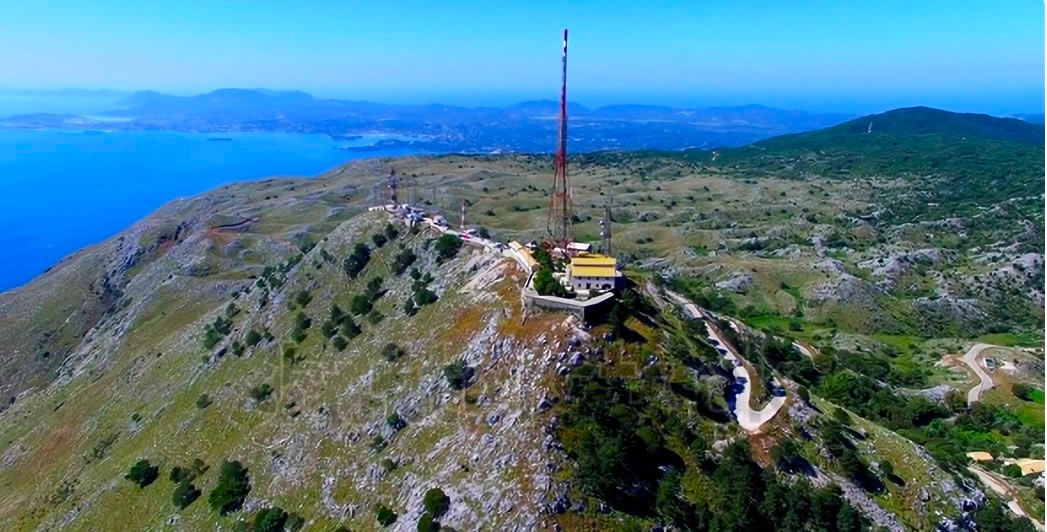
Agii Deka Radar Area — Central Corfu from Above
The mountain of Agii Deka rises to approximately 576 metres and is the second-highest summit on Corfu.
The upper area provides extensive views across central and eastern Corfu, including Corfu Town, the airport and surrounding countryside.
A radar installation stands near the summit, but the radar itself is a restricted facility and should not be treated as a tourist attraction.
Enjoy the surrounding mountain viewpoints and paths without attempting to enter fenced or restricted areas.
A documented hiking route also reaches the summit area from Ano Garouna.
Best for: hiking and high-level views across central Corfu.
Map: Agii Deka summit / Radar area
Kaiser’s Throne — Pelekas Panorama
Above Pelekas village is one of Corfu’s classic viewpoints, generally known as Kaiser’s Throne.
The location became associated with German Emperor Kaiser Wilhelm II, who enjoyed visiting the elevated area during his stays in Corfu.
From the observation point you can see across a huge section of central and western Corfu, with villages, olive-covered hills and the Ionian Sea spread below.
It is particularly popular around sunset.
My tip: Arrive before sunset rather than exactly at sunset. Parking and the small viewing area can become busy during peak season.
Best for: panoramic sunset views with easy access.
Map: Kaiser’s Throne
Chlomos — A Hilltop Village Above South Corfu
The correct name is Chlomos, rather than “Clomos”.
This traditional hilltop village in southern Corfu is included among the island’s historic countryside settlements and provides wide views over southeastern Corfu and the Ionian Sea.
The attraction here is not one single observation platform. Walk slowly through the old village and the views appear between houses, alleys and terraces.
Chlomos is particularly enjoyable for travellers who prefer a quieter panorama without crowds or organized tourist infrastructure.
Best for: traditional village atmosphere and southeast Corfu views.
Map: Chlomos village
Achilleion Imperial Gardens — Historic Views from Gastouri
The Achilleion, created for Empress Elisabeth of Austria, occupies an elevated position near Gastouri with gardens and terraces looking towards eastern Corfu.
As of August 2026, the palace interior remains unavailable to visitors during restoration work, but the outdoor areas and Imperial Gardens are open.
The official operator currently lists opening hours of 08:00–20:00 daily from April 1 to October 31 and 08:00–16:00 from November 1 to March 31.
From the gardens, statues of Achilles frame views across the surrounding countryside towards the sea.
Check the current status before travelling because restoration arrangements may change.
Best for: history, gardens and eastern Corfu scenery.
Map: Achilleion Gardens
Helidoni Viewpoint — A Quieter Northwest Stop
Helidoni is one of the less formal viewpoints in northwest Corfu.
The appeal is the elevated coastal landscape rather than facilities or a developed observation platform.
This makes it suitable for travellers deliberately searching for quieter scenic stops, but access and trail conditions should be checked locally.
Wear suitable shoes and do not assume that every track visible on a digital map is maintained for ordinary vehicles.
Best for: quieter northwest landscapes and photography.
Map: Helidoni viewpoint
Agios Gordios Viewpoint
The road descending towards Agios Gordios provides a memorable first view of the bay.
The long beach is framed by steep green hills, with the distinctive Ortholithi rock rising from the sea.
Several sections of road offer views, but only stop where there is genuinely enough space to pull completely clear of traffic.
Late afternoon brings particularly attractive light across the west-facing coastline.
Best for: beach panorama and sunset light.
Akrotiri Café — Between Arillas & Agios Stefanos
On the high cape between Arillas and Agios Stefanos Avliotes, Akrotiri Lounge Café combines a commercial café stop with an exceptional natural viewpoint.
The elevated terraces look towards both coastal areas and across the Ionian Sea towards the Diapontia Islands.
The café itself describes the sunset panorama as one of its main attractions, and the location remains especially popular in the late afternoon.
Because this is a private business rather than a public viewing platform, opening hours can change according to season.
Best for: sunset with a coffee, drink or meal.
Aerostato Viewpoint — Above Sinarades
The Aerostato area above Sinarades is another elevated west-coast viewpoint, overlooking the hills around Agios Gordios and the Ionian Sea.
It works particularly well as part of a drive through Sinarades and the villages of central-western Corfu.
The light becomes softer towards evening, making the area especially attractive around sunset.
Best for: Agios Gordios views and a relaxed scenic stop.
Map: Aerostato viewpoint
Ipsos Viewpoint — Looking Down from the Mountains
The mountain roads above Ipsos, particularly in the direction of Spartilas and Agios Markos, provide a completely different view of the resort.
From above, the long curve of Ipsos Bay, the narrow coastline and the mountains beyond become much more apparent than they do at beach level.
On clear days the view extends south towards Corfu Town and across the channel towards the mainland.
As with Troumpeta, this is mainly a roadside scenic area rather than a formal viewing platform, so choose a safe place to stop.
Best for: northeast-coast panorama.
Map: Ipsos viewpoint
Mount Pantokrator — Corfu’s Highest Viewpoint
If you want the biggest panorama on the island, head towards Mount Pantokrator.
At approximately 906 metres, Pantokrator is the highest mountain on Corfu.
The official Visit Corfu guide highlights the summit route for its panoramic views towards the Diapontia Islands and the opposite mainland coast.
On exceptionally clear days the landscape appears to stretch far beyond Corfu itself.
A monastery stands at the summit, and the final approach is steep and narrow. Drive slowly and be prepared to meet vehicles travelling in the opposite direction.
The mountain can also be reached as part of serious hiking routes.
Best for: the widest panorama in Corfu.
Map: Mount Pantokrator viewpoint
Which Corfu Viewpoint Should You Choose?
Best overall panorama: Mount Pantokrator
Best view of Paleokastritsa: Lakones / Golden Fox area
Best natural formation: Afionas overlooking Porto Timoni
Best sunset: Loggas, Kaiser’s Throne or Akrotiri
Best historic viewpoint: Angelokastro or the Old Fortress
Best iconic photograph: Kanoni and Pontikonisi
Best quiet village view: Chlomos
Best adventurous viewpoint: Agii Deka summit area
Best Viewpoints for Sunset
Corfu’s west and northwest coast naturally offer the strongest sunset locations because they face towards the open Ionian Sea.
My favourite areas for evening light include:
• Loggas
• Cape Drastis
• Afionas
• Kaiser’s Throne
• Agios Gordios
• Akrotiri between Arillas and Agios Stefanos
Lakones can also be beautiful in the evening, although its panorama is as impressive during daylight as it is around sunset.
Photography & Safety Tips
• Do not cross barriers for a photograph. This is especially important around the sandstone cliffs of northwest Corfu.
• Wear proper shoes for Porto Timoni, Angelokastro and mountain paths.
• Do not block mountain roads. Troumpeta, Ipsos and several other locations are roadside viewpoints rather than dedicated parking areas.
• Avoid the midday summer heat if reaching a viewpoint requires climbing.
• Carry water. Some remote locations have no facilities.
• Use extra caution after rain. Stone paths, cliffs and dirt roads can become slippery.
• Respect restricted areas. The radar installation at Agii Deka is not a visitor attraction.
Best Time to Explore Corfu’s Viewpoints
Spring: Perhaps the best overall season. The countryside is intensely green, visibility can be excellent and temperatures are comfortable.
Early summer: Long days and usually good visibility make it easy to combine several viewpoints.
July and August: Beautiful but hot and busy. Visit exposed locations early or later in the day.
September and October: Excellent for softer light, sunsets and fewer crowds.
Winter: Clear days can produce extraordinary long-distance views, although mountain weather and rain require more caution.
A Local Way to Explore Them
Do not try to collect every viewpoint in a single day.
Group them geographically instead.
For northwest Corfu, combine Paleokastritsa, Lakones, Angelokastro, Afionas, Loggas and Cape Drastis.
For central-west Corfu, combine Pelekas, Sinarades, Aerostato and Agios Gordios.
For the northeast, combine Ipsos, Spartilas and Mount Pantokrator.
For Corfu Town and the surrounding area, combine the Old Fortress, Kanoni and Achilleion.
Use our Corfu map to see how the different regions fit together before planning your drive.
Final Thoughts
Corfu’s best viewpoints are not all formal attractions with signs, tickets and observation decks.
Sometimes the memorable view appears from a village lane, an old fortress wall, a mountain road or a café terrace where you intended to stop for only ten minutes.
That is part of what makes exploring Corfu rewarding. The island changes dramatically when seen from above: beaches become small curves of colour, olive groves stretch across entire valleys and the sea seems to surround everything.
Take your time, stop only where it is safe and stay long enough to actually look rather than simply take a photograph.
My grandfather’s old description still fits: from the right place, you really can watch Corfu breathe.
Access, opening hours, road conditions and commercial-business hours can change. Check current information before making a special journey to a remote or ticketed viewpoint.