10 Secret Beaches in Corfu: Hidden Coves & Wild Shores
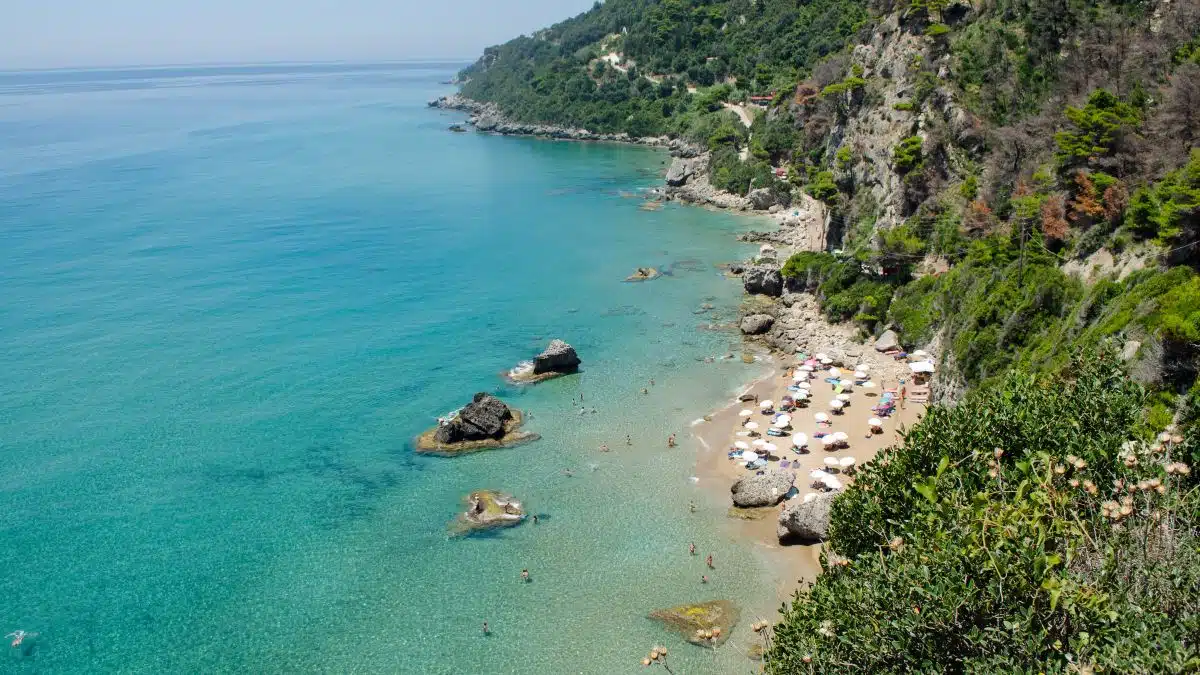
Corfu has dozens of famous beaches, but some of its most beautiful stretches of coastline are hidden beyond forest paths, beneath steep cliffs or completely inaccessible by road.
This guide focuses on beaches that still require a little effort to reach. Some involve a walk through olive groves, while others are best — or only — approached by boat.
Do not expect beach clubs, large car parks and rows of sunbeds at most of these places. Bring water, suitable shoes and everything else you may need for the day.
If easy access and full facilities are more important to you, see our guide to the best beaches in Corfu. But if you want something wilder, start here.
10 Hidden & Secluded Corfu Beaches at a Glance
• Rovinia Beach — Liapades, west coast — path or boat
• Myrtiotissa Beach — west coast — difficult road and walk
• Stelari Beach — Paleokastritsa/Liapades coast — boat access
• Chomi / Paradise Beach — west coast — boat only
• Limni Beach — near Liapades — walk or boat
• Iliodoros Beach — south of Liapades — boat only
• Giali Beach — below Giannades — boat strongly recommended
• Arkoudilas Beach — near Kavos — dirt road and walk
• Akoli Beach — Erimitis, northeast Corfu — hiking path or boat
• Aria Beach — Erimitis — hiking path or boat
Rovinia Beach — Liapades
Rovinia is no longer completely unknown, but it still feels considerably more natural than Corfu’s major resort beaches.
The small pebble cove lies close to Liapades, surrounded by dense vegetation and steep green slopes. The water is exceptionally clear and the rock formations make it an excellent place for swimming and snorkelling.
The official Visit Corfu guide states that after parking, visitors walk approximately 200 metres along a narrow rocky path to reach the beach.
You can also arrive by boat from Liapades.
There are no reliable full beach facilities, so bring water and anything else you need.
Access: Footpath or boat
Best for: Swimming, snorkelling and photography
My tip: Come early. Rovinia is hidden geographically, but it is definitely not a secret among people who know Corfu.
Myrtiotissa — Wild Beauty Below the Cliffs
Myrtiotissa is one of Corfu’s most beautiful west-coast beaches, squeezed between high green cliffs and the Ionian Sea.
It has long been known as an unofficial naturist beach, although naturists and non-naturists may both use the area.
The beach is sandy with rocks in the water and the surrounding cliffs create an unusually wild setting for somewhere relatively close to Corfu Town.
Unlike some older descriptions, Myrtiotissa is not necessarily completely unorganized. The official Visit Corfu information mentions sunbeds, umbrellas and a small canteen.
The difficult part is access. The road becomes extremely narrow, and the official guide recommends leaving your vehicle approximately a kilometre before the beach rather than attempting to drive all the way down.
Access: Narrow road followed by walking
Best for: Naturists, couples and wild scenery
My tip: Do not attempt the final narrow road in a large rental car simply because navigation tells you that you can.
Stelari Beach — A West-Coast Escape by Boat
Stelari lies along the spectacular coastline between Liapades and Paleokastritsa.
The beach is surrounded by steep green slopes and clear blue-green water, with no road bringing crowds directly to the shore.
For visitors, the practical way to reach Stelari is by boat. Boat taxis and rental boats operate from Paleokastritsa and Liapades during the tourism season.
Do not expect permanent facilities. Take water, sun protection and food rather than assuming something will be available when you arrive.
Access: Boat
Best for: Quiet swimming and a boat day along the west coast
Chomi / Paradise Beach — Accessible Only from the Sea
If one beach genuinely deserves the description “hidden”, it is Chomi, widely known as Paradise Beach.
Towering cliffs rise almost vertically behind a white-pebble shoreline, preventing normal land access.
The official Visit Corfu guide confirms that Chomi is accessible only from the sea, while Discover Greece also describes it as one of Corfu’s hidden coastal treasures.
Boat taxis, excursions and rental boats reach the beach from Paleokastritsa and nearby areas.
The approach from the water is arguably part of the experience: the cliffs open to reveal a beach that simply cannot be seen properly from the road network above.
Access: Boat only
Best for: Dramatic scenery and swimming
Safety: Avoid sitting immediately below unstable cliff faces. Natural rockfall can occur along steep coastal cliffs.
Limni Beach — Corfu’s Hidden Double Beach
Limni, near Liapades, has one of the most unusual shapes of any Corfu beach.
A narrow strip of white pebbles connects the mainland with a wooded rocky headland, creating water on both sides of the beach.
The beach is undeveloped and surrounded by nature.
You can reach Limni on foot through the Liapades countryside or more easily by boat from Liapades or Paleokastritsa.
The walking route can be rough and signage is not always obvious, so offline navigation or an up-to-date local route is useful.
Access: Footpath or boat
Best for: Snorkelling, nature and unusual photography
Bring: Water, food and proper footwear
Iliodoros — One of the Coast’s Least-Visited Coves
Iliodoros, sometimes written Heliodoros, lies south and west of Liapades beneath a rugged section of coastline.
This is a genuinely secluded beach with a mixture of sand and pebbles and no normal tourist development.
The safest and practical visitor access is by sea.
It can be combined with other hidden west-coast beaches during a boat trip from Liapades or Paleokastritsa.
Access: Boat
Best for: Visitors wanting somewhere considerably less known than Rovinia
Giali Beach — Beautiful but Difficult to Reach
Giali, also written Gyali or Yali, lies on Corfu’s west coast below the area of Giannades, not in the far northwest as it is sometimes incorrectly described.
It is one of the most genuinely isolated beaches on the island, with clear turquoise water, fine pebbles and high cliffs behind it.
There is a land route, but this is where visitors need to be particularly careful.
The descent has historically involved steep terrain, rocks, ropes and improvised sections. Current reports warn that conditions can deteriorate and that some assistance ropes may no longer be present.
For most visitors, I strongly recommend reaching Giali by boat or water taxi from Ermones rather than attempting the cliff descent.
Access: Boat strongly recommended; difficult hiking access exists
Best for: Experienced adventurers and boat trips
Not recommended for: Young children, anyone with mobility problems or inexperienced hikers attempting the land route
Arkoudilas Beach — Wild South Corfu
At the southern end of Corfu, close to Kavos, Arkoudilas feels almost like the opposite of the nearby resort.
The long sandy beach lies beneath high cliffs and has far less development than the busy shoreline around Kavos.
You can approach through the countryside by dirt road and then continue towards the beach.
Facilities are limited and may change according to season, so arrive prepared rather than assuming that umbrellas, food or drinks will be available.
The sea can become rougher than the sheltered east-coast beaches, particularly when wind increases.
Access: Dirt road and walking
Best for: Long walks, space and escaping the Kavos crowds
Important: Avoid digging into or rubbing cliff material onto your skin as a “natural spa treatment”. The cliffs are part of a fragile natural landscape, and removing clay or other material is unnecessary.
Akoli Beach — Inside Wild Erimitis
Akoli lies inside the beautiful Erimitis area of northeast Corfu, between Agios Stefanos Sinion and Avlaki.
This undeveloped landscape contains secluded beaches, woodland and coastal wetlands and is one of the most ecologically valuable parts of the island.
Akoli sits beside Akoli lagoon and has no normal road access to the beach itself.
Visitors reach it via the network of Erimitis walking paths or from the sea by boat.
This is the northeast coast at its wildest — very different from nearby organised resort beaches.
Access: Walking trail or boat
Best for: Hiking, quiet swimming and nature
If you are staying nearby, see our Kassiopi guide for more ideas around northeast Corfu.
Aria Beach — Another Erimitis Hideaway
Aria is another of the small secluded beaches reached from the Erimitis trail.
The walking route between Agios Stefanos Sinion and Avlaki crosses a remarkably undeveloped landscape of woodland, headlands, wetlands and small beaches.
A short descending path from the main trail leads to Aria.
There are no beach clubs or normal resort facilities here, which is precisely why the area remains special.
Access: Hiking path or boat
Best for: Combining swimming with an Erimitis nature walk
My tip: Stay on established paths. Erimitis is dense, ecologically sensitive terrain and wandering off-trail is neither necessary nor particularly practical.
Which Hidden Beach Should You Choose?
Easiest secret-beach experience: Rovinia
Most dramatic by boat: Chomi / Paradise Beach
Most unusual shape: Limni
Most adventurous: Giali
Best naturist option: Myrtiotissa
Best for a boat-hopping day: Stelari, Chomi and Iliodoros
Best in South Corfu: Arkoudilas
Best for hiking and swimming: Akoli and Aria in Erimitis
Boat or Hiking?
One reason these beaches remain relatively quiet is that normal road access is limited or nonexistent.
Along the Paleokastritsa and Liapades coastline, hiring a small boat or using a boat taxi can often be much easier than attempting difficult paths.
Boat access is especially useful for:
• Stelari
• Chomi / Paradise Beach
• Iliodoros
• Giali
• Limni
Before renting a boat, check local rules, weather conditions and the permitted navigation area. Some rental boats may have restrictions on where they can travel.
What to Bring to Corfu’s Remote Beaches
• Plenty of water — do not rely on a canteen being open.
• Food or snacks for completely undeveloped beaches.
• Sun protection — shade can disappear as the sun moves.
• Walking shoes for access paths; carry beach footwear separately.
• Water shoes if you dislike walking over pebbles.
• Offline map for remote trails.
• A charged phone, particularly if walking.
• A rubbish bag — if there are no bins, take everything back with you.
Important Safety Advice
A “secret beach” is not automatically a safe beach.
Many of Corfu’s hidden coves lie below cliffs or at the end of poorly maintained tracks.
Do not attempt difficult descents in flip-flops, and never follow an old online hiking description blindly. Paths can change because of erosion, vegetation, storms and rockfall.
At beaches below high cliffs, avoid sitting directly beneath unstable rock faces.
Sea conditions also matter. West-coast water can become rough even when the same morning looked completely calm.
Check our Corfu weather information before setting out by boat or attempting a remote coastal walk.
Are These Beaches Really Secret?
Not in the literal sense.
Rovinia and Myrtiotissa appear in guidebooks and social media, and Chomi is visited by excursion boats during summer.
What makes these beaches different is their limited road access, lack of large-scale development and more natural surroundings.
They are better thought of as Corfu’s hidden, secluded or harder-to-reach beaches rather than places nobody else knows about.
And that distinction matters: if you arrive at Rovinia at midday in August expecting to be the only person there, you are likely to be disappointed.
Final Thoughts
Corfu still has beaches where reaching the water feels like part of the adventure.
You may walk through an olive grove, follow an Erimitis forest trail or approach a wall of cliffs by small boat before the beach finally appears.
That extra effort is what protects many of these places from becoming ordinary resort beaches.
Go early, travel lightly and treat them carefully. Take your rubbish away, respect naturists where appropriate, stay on established paths and do not damage cliffs or vegetation.
The reward is a side of Corfu that still feels wonderfully wild — clear water, green cliffs and small stretches of shoreline with very little between you and the Ionian Sea.
Access paths, boat services and seasonal facilities can change. Always check current local conditions before attempting a remote beach, particularly Giali or other beaches reached by steep terrain.