Saint Spyridon’s Day in Corfu: December 12 Traditions & Local Guide
Few dates reveal the spiritual side of Corfu as clearly as December 12, the feast day of Saint Spyridon, the island’s patron saint.
While summer visitors may know Saint Spyridon from the great processions through Corfu Town, December is different. This is a deeply religious three-day celebration centred on the Church of Saint Spyridon, when thousands of Corfiots and pilgrims come to venerate the saint’s relics.
The Old Town is already dressed for Christmas, the smell of freshly fried loukoumades fills the streets around the church, people wish every Spyros and Spyridoula Chronia Polla, and families continue customs that have been passed down for generations.
Saint Spyridon’s Day at a Glance
• Main feast day: December 12
• Main location: Church of Saint Spyridon, Corfu Old Town
• Celebrations normally begin: December 11
• Traditional conclusion: December 13 with the return of the relics to the shrine, known locally as the Basmata
• Special tradition: The saint’s relics are placed upright near the church entrance for public veneration
• Traditional food: Loukoumades or tiganites tou Agiou
• December 12: Official local religious holiday in Corfu
Who Was Saint Spyridon?
Saint Spyridon was born in Cyprus in the late third century and is traditionally described as having begun life as a shepherd before becoming Bishop of Trimythous.
He participated in the First Ecumenical Council of Nicaea in 325 and became one of the best-known saints of the Orthodox Church.
His feast day is celebrated throughout the Orthodox world on December 12, but nowhere is his presence felt quite as strongly as in Corfu.
For Corfiots, Saint Spyridon is not simply a historical religious figure. He is regarded as the protector of the island, and local tradition credits his miraculous intervention with protecting Corfu during epidemics and during the Ottoman siege of 1716.
How Saint Spyridon’s Relics Came to Corfu
The saint died in the fourth century, and his relics remained in Cyprus for several centuries.
Towards the end of the seventh century they were transferred to Constantinople because of Arab raids against Cyprus.
After the fall of Constantinople, the relics were eventually brought west. According to the official history of the Holy Pilgrimage of Saint Spyridon, in 1456 the priest Gregory Polyeuktos carried the relics of Saint Spyridon together with those of Saint Theodora the Empress through Epirus and eventually to Corfu.
The relics of Saint Spyridon have remained on the island ever since.
The Church of Saint Spyridon
The present Church of Saint Spyridon in Corfu Old Town dates from the late 16th century and was inaugurated in 1589.
Its tall bell tower, with its distinctive red dome, is one of the most recognisable landmarks of the Old Town and can be seen rising above the surrounding Venetian buildings.
Inside the church, the saint’s relics are kept in an ornate silver reliquary positioned to the right of the sanctuary.
The current reliquary was made in Vienna in 1867.
The church also contains valuable icons, votive offerings and ecclesiastical objects accumulated during centuries of devotion to the saint.
If you would like to explore more of the island’s religious heritage, see our guide to Corfu’s churches, monasteries and religious sites.
December 11 — When “The Saint Comes Out”
The celebration begins on December 11, the eve of the feast.
At around midday according to the traditional programme, the saint’s sacred relics are ceremonially brought out from their normal position in the shrine.
Corfiots sometimes describe this simply as “the Saint comes out”.
The relic is placed upright near the entrance of the church — traditionally described as the Saint being “at the door” — so that worshippers can approach and venerate it.
This begins a three-day period of pilgrimage that continues through December 12 and concludes on December 13.
Evening Vespers, prayers and other religious services take place throughout this period, while large numbers of people continuously arrive at the church.
December 12 — Saint Spyridon’s Feast Day
December 12 is the main feast day.
The morning includes Matins and a solemn Hierarchical Divine Liturgy attended by church authorities, representatives of government and local institutions, as well as large numbers of worshippers.
Pilgrims may begin arriving very early, and queues around the narrow streets near the church can become substantial.
The atmosphere is very different from Corfu’s summer tourist season. This is predominantly a local and religious occasion, even though pilgrims also travel to Corfu from other parts of Greece and from abroad.
Important: There Is Not the Usual Street Procession on December 12
This is one point that is frequently confused in travel guides.
Saint Spyridon’s relic is famously carried through the streets of Corfu several times during the year, but the December feast is organised differently.
Instead of the large outdoor procession associated with dates such as August 11, the focus on December 12 is the three-day public veneration of the relic inside the church.
The relic is brought from its shrine and remains upright for worshippers before being returned following the conclusion of the celebrations on December 13.
So if you visit expecting the huge procession through Liston and Spianada that you may have seen in photographs from other Saint Spyridon celebrations, December 12 is not quite the same experience.
December 13 — The Basmata
The celebrations traditionally conclude on December 13.
After the final services, the saint’s relics are ceremonially returned to their usual position in the shrine.
This is known locally as the Basmata.
The precise timetable can vary from year to year, but recent programmes have placed the ceremony during the afternoon.
For Corfiots who have grown up with these traditions, the Basmata mark the quiet conclusion of three intense days of prayer, pilgrimage and celebration.
Loukoumades tou Agiou — The Taste of Saint Spyridon’s Day
There is another tradition that you will notice long before reaching the church: loukoumades.
On December 11 and 12, the aroma of freshly fried dough spreads through the streets of Corfu Town.
Known locally in connection with the feast as Loukoumades tou Agiou or Tiganites tou Agiou, these small pieces of fried dough are traditionally eaten during Saint Spyridon’s celebration.
They may be served with honey, sugar, cinnamon or other toppings depending on the household or stall.
The exact origins of the custom are uncertain. One local explanation links the food with pilgrims who remained awake during long overnight religious services and needed something warm and filling during cold December nights.
Whatever its origins, today loukoumades are inseparable from the atmosphere of Saint Spyridon’s feast.
My tip: Do not wait until the busiest period on December 12. Walk around the streets near the church on the evening of December 11, when the smell of loukoumades, Christmas lights and church bells already signal that the celebration has begun.
Saint Spyridon’s Day Is a Local Holiday
December 12 is an official local religious holiday in the Regional Unit of Corfu.
Public services and certain institutions therefore close for the day, while private businesses may operate according to their own or locally applicable holiday arrangements.
Cafés, restaurants and businesses serving visitors in central Corfu Town may still be active because so many people come into the centre for the celebration.
If you need a bank, public office or specific shop on December 12, check its opening hours in advance.
Why Are There So Many People Called Spyros in Corfu?
You will quickly notice that Spyros is an exceptionally common name in Corfu.
Spyros is the familiar form of Spyridon, while the female form Spyridoula is also common.
The popularity of the names reflects the extraordinary devotion Corfiot families have traditionally shown towards the island’s patron saint.
December 12 is therefore not only Saint Spyridon’s feast. It is also a huge collective name day.
Phones ring constantly, homes receive visitors and greetings of Chronia Polla are exchanged all over the island.
If you know someone in Corfu called Spyros or Spyridoula, December 12 is definitely a day to remember to contact them.
The Philharmonic Bands & Saint Spyridon
Corfu’s philharmonic societies have an extremely close relationship with the island’s religious traditions.
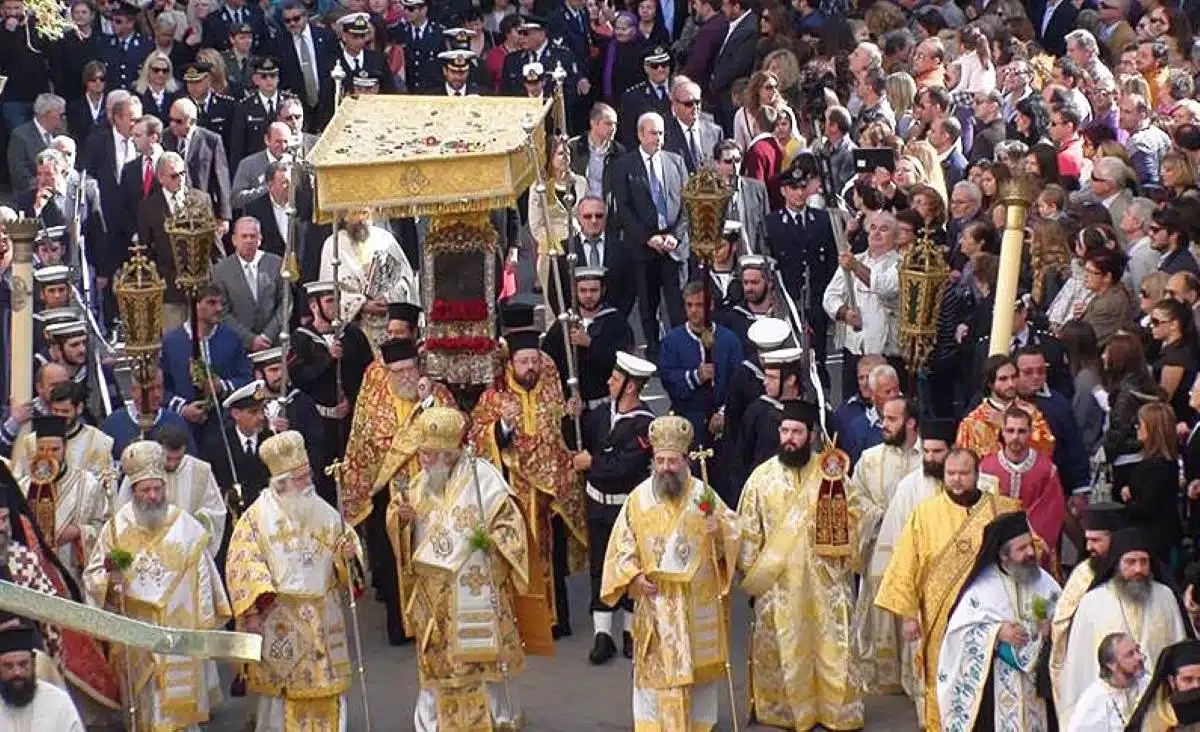
During the major outdoor processions of Saint Spyridon, bands accompany the relic through Corfu Town and the combination of music, architecture and religious ceremony creates some of the island’s most memorable public events.
On the December feast, however, the programme is focused much more heavily on worship inside the church. Philharmonic societies may hold concerts or participate in related celebrations, but visitors should not expect the same type of large marching procession seen at Easter or on August 11.
Read our guide to Corfu’s Philharmonic Bands to understand why music plays such an important role in the island’s traditions.
The Other Saint Spyridon Processions
If you specifically want to see Saint Spyridon’s relic carried through the streets with the philharmonic bands, there are several other important dates during the year.
• Palm Sunday: commemorating the saint’s protection of Corfu during an epidemic
• Holy Saturday: one of the island’s oldest Saint Spyridon processions
• August 11: commemorating the end of the Ottoman siege of Corfu in 1716
• First Sunday of November: connected with the island’s deliverance from another plague epidemic
Each procession has its own history, route and musical traditions.
If you are visiting during Holy Week, see our complete Easter in Corfu guide.
What Is Corfu Town Like on December 12?
December offers an atmosphere that summer visitors rarely see.
The Old Town is decorated for Christmas, lights hang across the narrow kantounia, cafés are filled with local residents rather than predominantly tourists and winter clothing replaces beachwear.
Around Saint Spyridon’s Church, however, the streets can become extremely busy as pilgrims arrive throughout the day.
The combination of Christmas lights, church bells, incense and the smell of loukoumades makes December 11–12 one of the most atmospheric periods of the Corfu winter.
If you are thinking about visiting the island outside summer, read our Winter in Corfu guide.
Best Time to Visit the Church
There is no completely crowd-free time during the main celebration.
The busiest periods tend to be around major religious services and during daytime hours on December 12.
If your main purpose is to experience the spiritual atmosphere rather than attend a specific service, visiting later in the evening or during quieter intervals can sometimes be more comfortable.
However, the programme changes slightly from year to year, so check the current schedule before planning your visit.
What to Wear
The Church of Saint Spyridon is an active Orthodox place of worship.
Dress respectfully, particularly during the feast.
You do not need formal clothing, but avoid beachwear, very revealing clothing or anything inappropriate for a religious service.
December in Corfu can also be cool and wet, especially in the evening, so bring a jacket and be prepared for rain.
Practical Tips for December 11–13
• Expect crowds: The streets immediately around Saint Spyridon Church become very busy.
• Walk if possible: Corfu Old Town is compact and parking near the centre can be difficult during major celebrations.
• Dress for winter: December evenings can be cold, damp and rainy.
• Respect worshippers: Avoid blocking the queue or holding up people in order to take photographs.
• Try the loukoumades: They are part of the December tradition rather than simply another sweet sold to tourists.
• Remember the local holiday: Public services and some businesses may be closed.
• Check the annual programme: Exact service times can change.
Photography Inside the Church
Saint Spyridon’s feast attracts many visitors, but it is primarily a religious pilgrimage.
Do not assume photography or video is appropriate simply because other people are using their phones.
Follow instructions from church staff, avoid photographing worshippers closely without permission and never obstruct the line of people waiting to venerate the saint.
There are plenty of opportunities to photograph the church exterior, bell tower, Christmas decorations and atmosphere of the surrounding Old Town without interfering with religious services.
Combine the Celebration with Corfu Old Town
December 12 is also an excellent opportunity to explore Corfu Town without the crowds and heat of midsummer.
Saint Spyridon’s Church is only a short walk from Liston, Spianada, Campiello, the Old Fortress and the Palace of Saint Michael and Saint George.
Allow yourself enough time to wander through the Old Town before or after visiting the church rather than arriving only for the religious ceremony and leaving immediately.
Check our Corfu Events Calendar as well, because concerts and Christmas events often take place around the same period.
Why Saint Spyridon’s Day Matters So Much
Visitors sometimes describe December 12 as a festival, but that word does not quite explain what the day means to Corfiots.
It certainly has a social side. People meet friends, eat loukoumades, exchange name-day wishes and fill the cafés of the Old Town.
But underneath all of that is a strong religious tradition.
For centuries, generations of Corfiot families have prayed to Saint Spyridon, named children after him and connected some of the island’s most difficult moments with stories of his protection.
That is why December 12 feels different from an ordinary celebration.
Final Thoughts
Saint Spyridon’s Day is one of the best occasions to experience a Corfu that most summer visitors never see.
There are no beach bars or excursion boats involved. Instead there are winter streets glowing with Christmas lights, queues of pilgrims outside a centuries-old church, families wishing each other Chronia Polla and the smell of hot loukoumades drifting through the Old Town.
Come respectfully and without rushing. You do not have to share the religious beliefs of the people around you to appreciate the importance of what you are witnessing.
For Corfu, Saint Spyridon is not simply a saint whose name appears on a church. His presence is woven into the island’s history, families, music and traditions — and on December 12 that connection becomes especially visible.
The exact programme of services for December 11–13 is announced each year. Always check the current schedule before travelling specifically for a particular service or ceremony.