Essential Greek Phrases for Travelers in Corfu
You do not need to speak Greek to enjoy Corfu. English is widely spoken in hotels, restaurants, shops and most tourism businesses, particularly in Corfu Town and the main resorts.
Still, learning a few Greek words before your trip makes everyday interactions more enjoyable. Even a simple Kalimera in the morning or Efharisto after a meal is usually appreciated.
Do not worry about getting every sound exactly right. Most Corfiots will understand what you are trying to say, and the effort matters much more than perfect pronunciation.
Basic Greek Phrases Every Visitor Should Know
Hello — Γεια σας
YAH sas
Polite or plural form. Use this with people you do not know, older people or when greeting more than one person.
Hello — Γεια σου
YAH sou
Informal singular form, normally used with friends, children or someone you already know well.
Good morning — Καλημέρα
Kah-lee-MEH-rah
Good evening — Καλησπέρα
Kah-lee-SPEH-rah
Good night — Καληνύχτα
Kah-lee-NEEKH-tah
Please — Παρακαλώ
Pa-ra-ka-LOH
Thank you — Ευχαριστώ
Ef-ha-ri-STOH
Thank you very much — Ευχαριστώ πολύ
Ef-ha-ri-STOH po-LEE
You’re welcome — Παρακαλώ
Pa-ra-ka-LOH
Yes — Ναι
NEH
No — Όχι
OH-hee
Excuse me / Sorry — Συγγνώμη
See-GHNO-mee
It’s OK / Never mind — Δεν πειράζει
Then pee-RAH-zee
See you — Τα λέμε
Ta LEH-meh
Goodbye — Αντίο
An-DEE-oh
Useful Greek for Restaurants & Tavernas
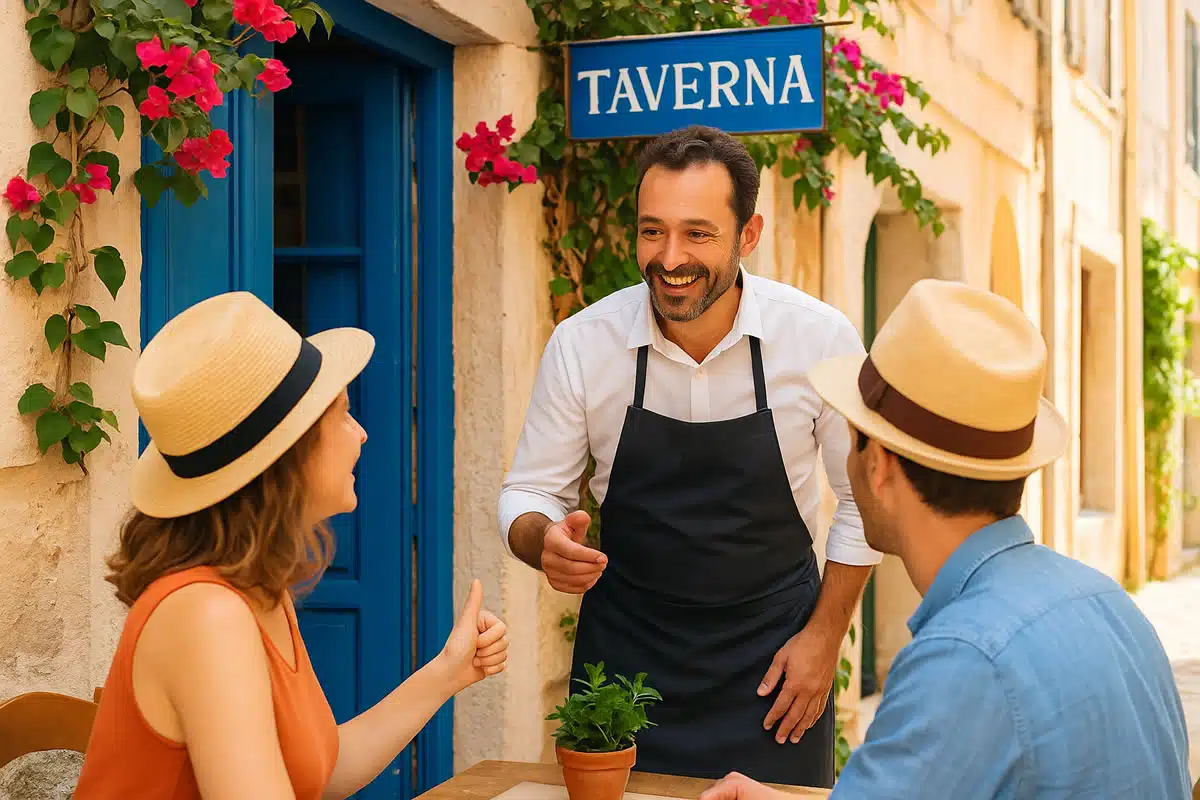
Corfu has plenty of restaurants where English menus are available, but these phrases are still useful — especially in smaller family-run tavernas.
A table for two, please — Ένα τραπέζι για δύο, παρακαλώ
EH-na tra-PEH-zee ya THEE-oh, pa-ra-ka-LOH
The menu, please — Το μενού, παρακαλώ
To meh-NOO, pa-ra-ka-LOH
Water, please — Νερό, παρακαλώ
Neh-ROH, pa-ra-ka-LOH
One beer, please — Μία μπύρα, παρακαλώ
MEE-ah BEE-ra, pa-ra-ka-LOH
One coffee, please — Έναν καφέ, παρακαλώ
EH-nan ka-FEH, pa-ra-ka-LOH
What do you recommend? — Τι προτείνετε;
Tee pro-TEE-neh-teh?
Very tasty! — Πολύ νόστιμο!
Po-LEE NO-stee-mo!
The bill, please — Τον λογαριασμό, παρακαλώ
Ton lo-gha-ria-SMOH, pa-ra-ka-LOH
Can I pay by card? — Μπορώ να πληρώσω με κάρτα;
Bo-ROH na plee-RO-so meh KAR-ta?
Cheers! — Γεια μας!
YAH mas!
You may also hear Στην υγειά μας — Stin yee-AH mas, meaning roughly “to our health”. Both are commonly used when making a toast.
If you want to discover what to order beyond the usual tourist menu, see our guide to authentic food spots in Corfu.
Useful Greek for Shopping
How much is it? — Πόσο κάνει;
POH-so KA-nee?
How much does this cost? — Πόσο κοστίζει αυτό;
POH-so ko-STEE-zee af-TOH?
Do you accept cards? — Δέχεστε κάρτες;
THEH-he-steh KAR-tes?
I would like this — Θα ήθελα αυτό
Tha EE-the-la af-TOH
Do you have something cheaper? — Έχετε κάτι πιο φθηνό;
EH-he-teh KA-tee pyo fthee-NOH?
Just looking, thank you — Απλώς κοιτάζω, ευχαριστώ
A-PLOS kee-TA-zo, ef-ha-ri-STOH
Directions & Getting Around
Where is…? — Πού είναι…;
Poo EE-neh…?
Where is the beach? — Πού είναι η παραλία;
Poo EE-neh ee pa-ra-LEE-ah?
Where is the bus stop? — Πού είναι η στάση του λεωφορείου;
Poo EE-neh ee STA-see too le-o-fo-REE-oo?
Where is the taxi rank? — Πού είναι η πιάτσα ταξί;
Poo EE-neh ee PYAT-sa tak-SEE?
Where is the port? — Πού είναι το λιμάνι;
Poo EE-neh to lee-MAH-nee?
Where is the airport? — Πού είναι το αεροδρόμιο;
Poo EE-neh to a-eh-ro-THRO-mee-o?
Left — Αριστερά
A-ree-steh-RAH
Right — Δεξιά
Thek-see-AH
Straight ahead — Ευθεία
Ef-THEE-ah
Near — Κοντά
Kon-DAH
Far — Μακριά
Ma-kree-AH
How far is it? — Πόσο μακριά είναι;
POH-so ma-kree-AH EE-neh?
For buses, taxis, transfers and rental cars, see our Getting Around Corfu guide.
At the Bus Station
One ticket to Corfu Town, please — Ένα εισιτήριο για την πόλη, παρακαλώ
EH-na ee-see-TEE-ree-o ya teen POH-lee, pa-ra-ka-LOH
One ticket to Paleokastritsa, please — Ένα εισιτήριο για την Παλαιοκαστρίτσα, παρακαλώ
EH-na ee-see-TEE-ree-o ya teen Pa-leh-o-ka-STREE-tsa, pa-ra-ka-LOH
What time does the bus leave? — Τι ώρα φεύγει το λεωφορείο;
Tee OH-ra FEV-yee to le-o-fo-REE-o?
Is this the bus to Kassiopi? — Αυτό είναι το λεωφορείο για Κασσιόπη;
Af-TOH EE-neh to le-o-fo-REE-o ya Ka-see-OH-pee?
At the Beach
Beach — Παραλία
Pa-ra-LEE-ah
Sea — Θάλασσα
THA-la-sa
Umbrella — Ομπρέλα
Om-BREH-la
Sunbed — Ξαπλώστρα
Ksa-PLO-stra
Is the sea safe today? — Είναι ασφαλής η θάλασσα σήμερα;
EE-neh as-fa-LEES ee THA-la-sa SEE-meh-ra?
Is it deep? — Είναι βαθιά;
EE-neh va-THYAH?
Useful Words for Food & Drink
Taverna — Ταβέρνα
Ta-VER-na
Restaurant — Εστιατόριο
Es-tee-a-TOH-ree-o
Coffee — Καφές
Ka-FES
Water — Νερό
Neh-ROH
Wine — Κρασί
Kra-SEE
Beer — Μπύρα
BEE-ra
Fish — Ψάρι
PSA-ree
Meat — Κρέας
KREH-as
Bread — Ψωμί
Pso-MEE
Delicious — Νόστιμο
NO-stee-mo
Do You Speak English?
One phrase that can rescue almost any conversation is:
Do you speak English? — Μιλάτε αγγλικά;
Mee-LAH-teh an-glee-KAH?
The polite plural form milate is appropriate when speaking to somebody you do not know.
If you want to explain that you know only a little Greek:
I speak a little Greek — Μιλάω λίγο ελληνικά
Mee-LAH-o LEE-go el-lee-nee-KAH
I don’t understand — Δεν καταλαβαίνω
Then ka-ta-la-VEH-no
Please speak slowly — Μιλήστε πιο αργά, παρακαλώ
Mee-LEE-steh pyo ar-GHA, pa-ra-ka-LOH
Can you repeat that? — Μπορείτε να το επαναλάβετε;
Bo-REE-teh na to eh-pa-na-LA-veh-teh?
Useful Greek in an Emergency
Hopefully you will never need these phrases, but they are worth knowing.
Help! — Βοήθεια!
Vo-EE-thee-ah!
Call an ambulance — Καλέστε ασθενοφόρο
Ka-LE-steh as-the-no-FO-ro
Call the police — Καλέστε την αστυνομία
Ka-LE-steh teen a-stee-no-MEE-ah
I need a doctor — Χρειάζομαι γιατρό
Khree-AH-zo-me ya-TRO
Where is the pharmacy? — Πού είναι το φαρμακείο;
Poo EE-neh to far-ma-KEE-o?
I am lost — Έχω χαθεί
EH-ho ha-THEE
The main European emergency number in Greece is 112. You can find more useful numbers in our Corfu emergency contacts guide.
Greek Numbers You May Find Useful
One — Ένα — EH-na
Two — Δύο — THEE-o
Three — Τρία — TREE-ah
Four — Τέσσερα — TEH-se-ra
Five — Πέντε — PEN-deh
Six — Έξι — EK-see
Seven — Επτά — Eh-PTA
Eight — Οκτώ — Ok-TOH
Nine — Εννέα — Eh-NEH-ah
Ten — Δέκα — THEH-ka
Ya Sas or Ya Sou?
This is one of the easiest Greek differences for visitors to learn.
Γεια σας — Ya sas is polite and can also be used when speaking to several people.
Γεια σου — Ya sou is informal and singular.
You do not have to be excessively formal in Corfu, but if you are greeting a stranger, hotel owner, shopkeeper or older person, Ya sas is the safest choice.
Once somebody begins speaking to you informally, using Ya sou usually feels perfectly natural.
Kalimera, Kalispera or Kalinihta?
Kalimera means good morning and is normally used from the morning until around midday or early afternoon.
Kalispera means good evening and is used from later in the day when greeting somebody.
Kalinihta means good night and is normally said when leaving or going to bed — not when arriving at a restaurant in the evening.
So if you walk into a taverna at 20:00, say Kalispera, not Kalinihta.
A Small but Important Thing About “Ne”
One Greek word occasionally confuses English-speaking visitors:
Ναι — Ne — means YES.
Because it sounds somewhat like the English word “nay”, it can initially sound as though somebody is saying no.
The Greek word for no is Όχι — Ohi.
Greek Body Language: Yes & No
Body language can occasionally cause confusion too.
A normal nod of the head generally indicates yes, just as it does in many other countries.
For no, Greeks may make a quick upward movement of the head or eyebrows, sometimes accompanied by a small clicking or ts sound.
To somebody unfamiliar with the gesture, this can look surprisingly subtle.
Do not worry too much about learning the gestures yourself. Simply knowing what they mean can prevent the occasional misunderstanding.
Don’t Try Too Hard to Sound Greek
You do not need to memorize dozens of expressions before your holiday.
If you remember just these six, you will already be doing well:
• Kalimera — Good morning
• Ya sas — Hello
• Parakalo — Please / You’re welcome
• Efharisto — Thank you
• Signomi — Excuse me / Sorry
• Ya mas — Cheers
A friendly attempt followed by a smile normally works much better than trying to deliver a complicated Greek sentence from memory.
Do People Speak English in Corfu?
Yes, very widely.
Corfu has been an international tourism destination for decades, so English is commonly spoken in hotels, restaurants, bars, car-rental offices, excursion companies and other tourism businesses.
In Corfu Town and major resorts you can comfortably travel without speaking Greek.
In smaller villages, particularly when speaking with older residents, English may be more limited. This is where even a few Greek words become especially useful.
Do not assume, however, that everybody should speak English. You are visiting Greece, and beginning with a Greek greeting before switching to English is a small gesture of courtesy.
My Local Tip
If you learn only one extra habit, use Kalimera.
Walk into a bakery, café or small village shop in the morning and say Kalimera before asking for what you need.
It takes one second, but it immediately makes the interaction feel less like a transaction between a tourist and a business and more like an ordinary conversation between two people.
And do not be embarrassed if your pronunciation is imperfect. Most of us would much rather hear an imperfect Efharisto than see someone avoid Greek completely because they are worried about getting it wrong.
Final Thoughts
You can have an excellent holiday in Corfu speaking nothing but English.
But a few Greek words add something to the experience.
Say Kalimera when you enter the bakery, Parakalo when ordering, Efharisto when somebody helps you and Ya mas when you raise a glass at dinner.
No one expects perfect grammar or pronunciation.
The purpose is simply to show that while you are visiting Corfu, you are willing to meet the people who live here halfway.
And when it is time to leave, there is an easy phrase that feels much nicer than goodbye:
Τα λέμε — Ta leme — See you.