Hiking & Forest Trails in Corfu: Best Walks Through Nature
Most visitors discover Corfu from the beach or behind the wheel of a car, but walking reveals a completely different island.
Old stone paths climb through centuries-old olive groves, mountain tracks cross forests and abandoned agricultural terraces, and coastal routes lead past dunes, wetlands, villages and viewpoints that are easy to miss from the road.
Corfu also has a surprisingly extensive walking network. The famous Corfu Trail crosses approximately 180 km of the island from south to north, while shorter local paths make it possible to experience the same landscapes without committing to a multi-day hike.
Below are some of the most interesting walks and hiking areas in Corfu, ranging from easy woodland strolls to demanding mountain routes.
Best Hiking Areas in Corfu at a Glance
• Paleokastritsa to Lakones — old cobbled paths and spectacular west-coast views
• Agii Deka Mountain — Corfu’s second-highest peak at 576 metres
• Mount Pantokrator & Old Perithia — mountain scenery, oak woodland and historic villages
• Kalafationes Forest — easy woodland walk through springs, pine and oak
• Issos & Lake Korission — sand dunes, wetlands and birdlife
• Mon Repos — easy shaded walking close to Corfu Town
• Loutses & Megali Grava Cave — dramatic limestone landscape in northern Corfu
• Nymfes Waterfalls — one of the easiest nature walks for families
• Sokraki & Spartilas — forest tracks and traditional mountain villages
• The Corfu Trail — approximately 180 km across the island
Paleokastritsa to Lakones
One of the classic walking experiences on Corfu’s west coast is the climb from Paleokastritsa towards the traditional village of Lakones.
The official Corfu Trail climbs from Paleokastritsa through a network of old cobbled footpaths to Lakones before continuing towards Makrades and northern Corfu.
The climb is steep in places, but the reward is a succession of extraordinary views across Paleokastritsa’s bays and the Ionian Sea.
Lakones itself is a traditional hillside village, and the nearby Bella Vista area provides some of the most famous panoramic views on the island.
More ambitious hikers can continue towards Makrades, Krini and the area around Angelokastro rather than returning immediately to Paleokastritsa.
Difficulty: Moderate, with a sustained uphill section.
My tip: Walk early in the morning or later in the afternoon. The ascent can feel much harder under the midday summer sun.
The Corfu Trail: Paleokastritsa, Lakones & Agios Georgios Pagon
If you want to turn the Paleokastritsa walk into a serious hike, this section of the Corfu Trail is one of the island’s highlights.
The trail climbs from Paleokastritsa to Lakones, continues along old paths towards Makrades and then descends through olive-covered countryside towards Agios Georgios Pagon.
The full official section continues much farther, eventually reaching Agros, so hikers should not assume this is simply a short circular walk.
This part of Corfu combines almost everything that makes walking on the island special: old villages, olive groves, mountain views and the west coast appearing repeatedly below you.
Agii Deka Mountain — Corfu’s Second-Highest Peak
Agii Deka rises to approximately 576 metres, making it Corfu’s second-highest mountain after Pantokrator.
One of the official Corfu Trail sections approaches the mountain from Stavros, skirts its slopes and then climbs sharply from Ano Garouna towards the summit.
Near the top is an old monastery enclosure that provides a memorable resting point before the route descends along an old cobbled mule path towards Agii Deka village.
From the higher slopes there are wide views across central Corfu and towards both sides of the island.
Difficulty: Moderate to challenging, mainly because of the steep ascent.
My tip: Do not underestimate this route simply because Corfu’s mountains are not particularly high. The ascent becomes demanding in summer heat.
Mount Pantokrator & the Northern Mountains
The highest point on Corfu is Mount Pantokrator, rising to approximately 906 metres above sea level.
The mountain and its surrounding plateau offer some of the wildest hiking scenery on the island.
The northern section of the Corfu Trail climbs from the Spartilas area through mountain paths and woodland before crossing the limestone landscape beneath Pantokrator.
One particularly attractive section passes through a natural tunnel of oak trees before reaching the open karst plateau.
From the higher areas, clear days can bring views across northern Corfu towards Albania and the mainland.
This is one of the places where Corfu feels more like a mainland mountain landscape than a Mediterranean beach island.
Old Perithia & the Pantokrator Slopes
Old Perithia is one of the most atmospheric bases for walking in northern Corfu.
The historic stone village sits on the slopes beneath Pantokrator and is surrounded by old agricultural land, churches, terraces and mountain paths.
The Corfu Trail approaches Old Perithia from the mountains before continuing north towards Agios Spyridon.
Rather than advertising one fixed “5 km Old Perithia Loop”, it is better to think of the village as a starting point for several possible walks of different lengths.
Some visitors simply explore the lanes and surrounding countryside, while experienced hikers can connect with longer sections of the Corfu Trail.
My tip: Old Perithia is particularly enjoyable in spring or autumn when walking temperatures are comfortable and the surrounding landscape is greener.
Sokraki to Spartilas
The mountain villages of Sokraki and Spartilas sit within one of northern Corfu’s most attractive hiking areas.
Sections of the Corfu Trail connect the region through tracks, old paths, woodland and cultivated land.
Sokraki itself sits high above the surrounding countryside and is a good place to stop for coffee or food before continuing.
The walking here provides a very different Corfu experience from the beaches below: forest shade, mountain settlements, olive groves and long-distance views dominate the landscape.
Kalafationes Forest Walk
For something shorter and easier, Kalafationes has one of Corfu’s best documented woodland walks.
The Corfu Paths route known as “A Walk in Kalafationes Forest” is approximately 4.1 km and normally takes around 1 hour 50 minutes.
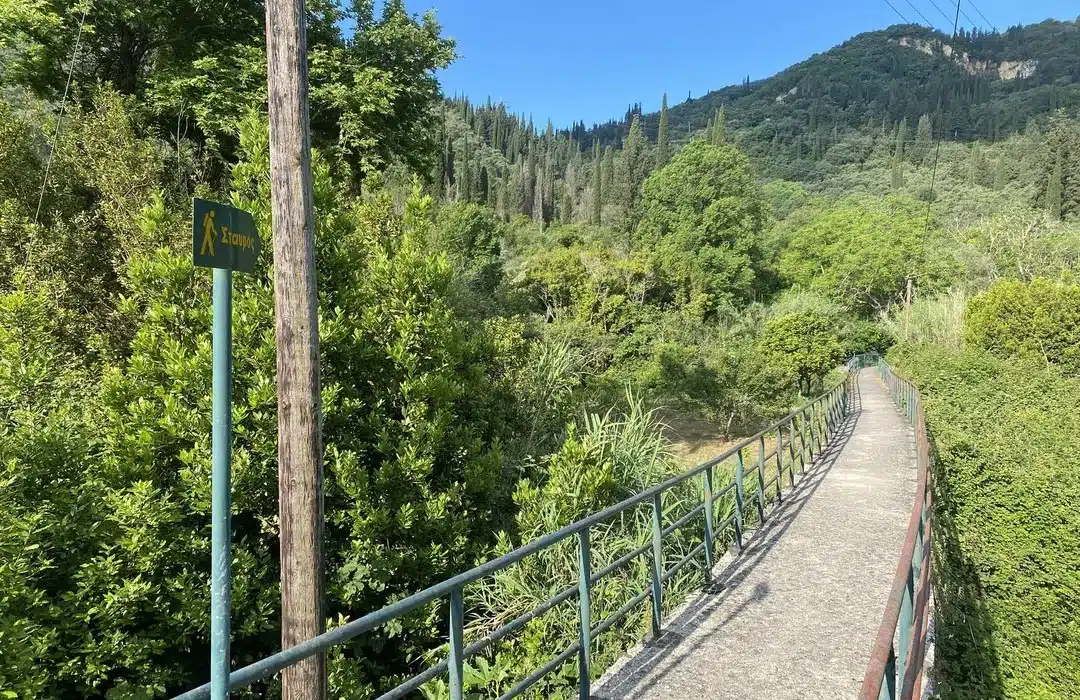
The walk begins around Kalafationes village and follows the old Louka path towards traditional springs including Kanali and Vourlila.
The landscape includes pine, oak, cypress, holly, myrtle and chestnut vegetation as well as sections of old agricultural countryside.
Difficulty: Easy.
This is a good choice if you want a genuine nature walk without committing to one of Corfu’s longer mountain trails.
Nymfes Waterfalls
Northern Corfu also offers one of the easiest walks for families: the route to the Nymfes Waterfalls.
The village of Nymfes lies among cypress, plane and oak trees on the green lower slopes of the Pantokrator region.
From the village, a dirt road continues for approximately 1.5 km towards the main parking area. From there, a short and relatively easy path leads towards the waterfalls.
The amount of water naturally varies considerably through the year, so the waterfalls are generally more impressive outside the driest part of summer.
Difficulty: Easy.
Best for: Families, short nature walks and visitors who do not want a demanding mountain hike.
Issos Beach & Lake Korission
Not every great Corfu walk involves mountains.
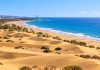
At Issos, enormous sand dunes separate the Ionian Sea from Lake Korission, one of Corfu’s most important wetland environments.
The Corfu Trail crosses this landscape, passing through dunes and vegetation before reaching the lake.
The wider wetland provides habitat for many bird species, making it particularly interesting during migration periods.
You may encounter herons and other waterbirds, while flamingos can sometimes be present during suitable periods of the year. They should never be presented as something visitors are guaranteed to see.
The landscape is very exposed, with far less shade than Corfu’s woodland trails.
My tip: Avoid a long walk across the dunes in the middle of an August afternoon. Early morning and the hours before sunset are far more comfortable.
Mon Repos Park
If you want an easy green walk without leaving the Corfu Town area, Mon Repos is an excellent option.
The large historic estate contains mature trees, shaded paths, archaeological remains and the Mon Repos mansion, which today houses the Museum of Palaiopolis.
Walking through the park provides a peaceful contrast to the traffic and busy streets only a short distance away.
You can also combine the estate with the archaeological remains of ancient Corcyra and a walk around the wider Kanoni and Palaiopolis area.
Difficulty: Easy.
Best for: Families, history lovers, summer shade and visitors staying in Corfu Town.
Megali Grava Cave at Loutses
Near the village of Loutses in northern Corfu lies the impressive Megali Grava, also known as Ano Grava or Peristerograva.
The enormous cave entrance lies in a dramatic limestone depression high above the surrounding countryside.
Reaching the entrance involves a steep final descent beside large rock walls. The path can become slippery, particularly after rain, so good footwear is important.
The cave has a vast main chamber and geological formations, with stalactites present in some sections.
This should be treated as a nature excursion rather than a developed show cave. There are no illuminated walkways or tourist infrastructure inside.
My tip: Do not explore deep cave passages without appropriate experience and equipment. The outdoor landscape and enormous entrance alone make the visit worthwhile.
Gardiki Castle & Agios Matthaios Countryside
The area around Gardiki Castle and Agios Matthaios is excellent for combining history with countryside walking.
Rather than one formally defined hiking circuit, there is a network of rural roads and tracks passing through olive groves and agricultural landscapes around the medieval castle.
This makes the area suitable for creating a shorter exploratory walk, but visitors should use a reliable hiking map or GPS route rather than assuming every visible farm track is public or leads back to the starting point.
Nearby, Lake Korission and the west-coast dunes provide a completely different landscape for the same day.
The Corfu Trail — 180 km Across the Island
For serious walkers, the Corfu Trail is the island’s great long-distance route.
Approximately 180 km long, it crosses Corfu from the south towards the northern coast, deliberately avoiding many of the island’s busiest roads and resort areas.
Its route includes beaches, dunes, wetlands, olive groves, traditional villages, mountain paths and historic sites.
Among the landscapes encountered are:
• Lake Korission and the south-western dunes
• The villages of central Corfu
• Agii Deka Mountain
• Pelekas and the west coast
• Liapades and Paleokastritsa
• Lakones and Agios Georgios Pagon
• Sokraki and Spartilas
• The slopes below Mount Pantokrator
• Old Perithia
• The northern wetlands around Agios Spyridon
You do not need to walk all 180 km. Many visitors choose one or two sections as day hikes.
When Is the Best Time for Hiking in Corfu?
March to May is arguably the best period. The island is intensely green, wildflowers are everywhere and temperatures are generally much more comfortable for long walks.
October and November can also be excellent, although rain can make old stone paths and steep tracks slippery.
Summer hiking is possible, but July and August require much more planning. Start early, carry plenty of water and avoid exposed mountain or dune routes during the hottest part of the day.
Check our Corfu weather guide before planning a long hike.
Hiking Safety in Corfu
Corfu’s landscape looks gentle from the coast, but hiking conditions can change quickly.
• Carry enough water. Do not assume you will find a café or spring on every route.
• Wear proper footwear. Old cobbled paths become surprisingly slippery.
• Use offline maps or GPS. Mobile reception is generally good, but not perfect everywhere.
• Avoid midday summer heat. Some sections have almost no shade.
• Do not enter private land. Olive groves and agricultural tracks may be privately owned.
• Watch for traffic. Some routes briefly join ordinary roads.
• Tell someone where you are going if attempting a remote mountain walk alone.
• Be particularly careful after rain. Rock, clay and polished cobbled paths can become extremely slippery.
Wildlife & Nature
Walking is also one of the best ways to appreciate Corfu’s biodiversity.
Depending on the area and season, you may encounter butterflies, reptiles, birds of prey and many species of woodland and wetland birds.
Lake Korission and the northern wetlands are particularly valuable for birdlife, while Corfu’s olive groves provide a completely different ecosystem.
Observe wildlife from a distance and avoid disturbing nesting birds or animals simply to get a photograph.
What About Corfu Donkey Rescue?
Corfu Donkey Rescue is a genuine animal sanctuary surrounded by countryside and olive trees, but it should not be described as one of Corfu’s established hiking trails.
Visitors can reach the sanctuary and spend time with rescued donkeys during its published opening hours, but it is better considered an animal-welfare visit that can be combined with exploring the surrounding countryside.
If visiting, follow the sanctuary’s current visitor instructions and do not feed the animals unless staff specifically allow it.
Which Walk Should You Choose?
For spectacular views: Paleokastritsa to Lakones
For a mountain challenge: Agii Deka or the Pantokrator area
For an easy forest walk: Kalafationes
For families: Nymfes Waterfalls or Mon Repos
For birds and wetlands: Issos and Lake Korission
For history and nature together: Old Perithia or Mon Repos
For something unusual: Megali Grava Cave at Loutses
For serious hikers: One or more stages of the Corfu Trail
Final Thoughts
Corfu is much more rewarding on foot than many visitors expect.
The island’s old paths were once practical routes connecting villages, fields, monasteries and coastal communities. Today they provide a way to discover a quieter Corfu hidden behind the resorts and main roads.
Walk through an olive grove before breakfast, climb above Paleokastritsa, cross the dunes beside Lake Korission or follow an old mountain path beneath Pantokrator and you begin to see why Corfu’s landscape has inspired travellers for centuries.
Just choose the route carefully, carry enough water and leave yourself enough time to stop. On Corfu, some of the best moments on a walk are usually the ones that were never marked as an attraction on the map.
Trail conditions can change because of vegetation, weather, erosion or maintenance. Distances and access should always be checked against an up-to-date hiking map or GPS route before starting a longer walk.