
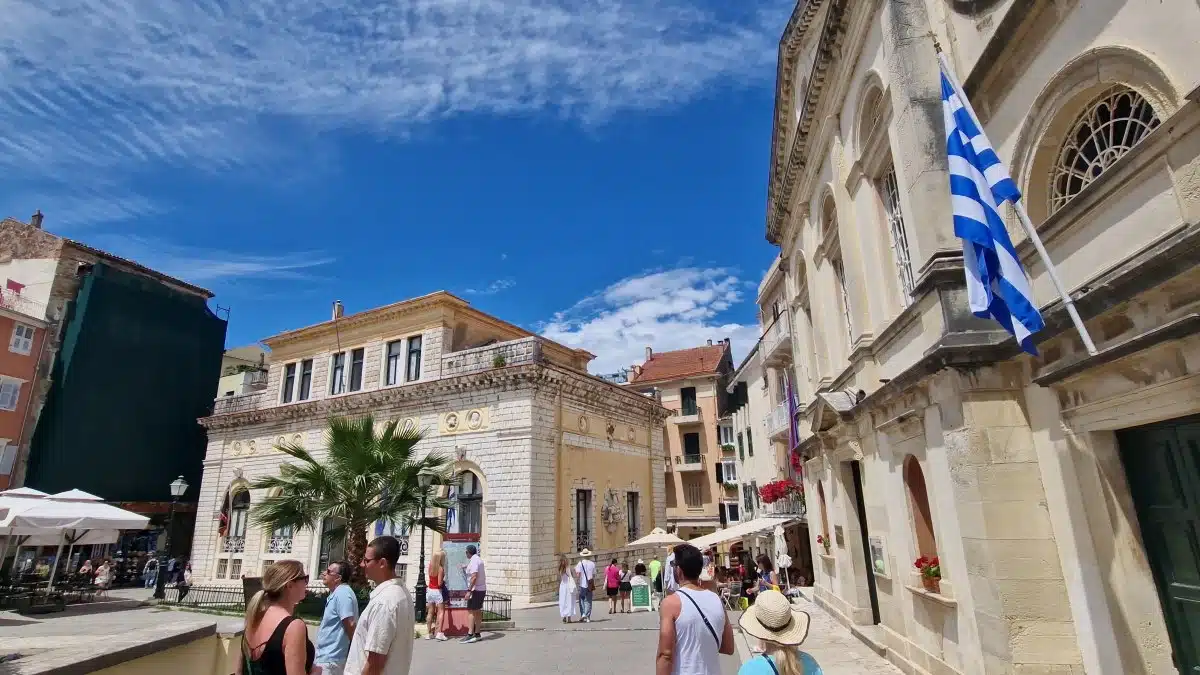
Corfu Old Town: A UNESCO Jewel of History & Living Traditions
Corfu Old Town is unlike anywhere else in the Greek islands. Instead of whitewashed Cycladic houses, you will find Venetian façades, French arcades, British neoclassical monuments, narrow stone-paved alleys and two imposing fortresses overlooking the Ionian Sea.
But what makes the Old Town special is that it is not simply a collection of historic monuments. People still live above the shops, children play in small squares, church bells echo through the kantounia, students fill the cafés during winter and local families continue traditions that have survived for generations.
This guide will take you through the main sights, hidden streets, churches, markets and local experiences that make Corfu Town one of the most fascinating historic centres in Greece.
Corfu Old Town at a Glance
• UNESCO World Heritage Site since 2007
• Old Fortress — Venetian fortifications, panoramic views and historic buildings
• New Fortress — massive defensive walls above the Old Port
• Spianada Square — the enormous open square at the heart of the city
• Liston — elegant arcades created during the French period
• Saint Spyridon Church — home of the relics of Corfu’s patron saint
• Campiello — one of the oldest and most atmospheric quarters of the town
• Local Market — fresh fish, vegetables, herbs and Corfiot products
• Palace of Saint Michael & Saint George — home to the Museum of Asian Art and Municipal Gallery
A UNESCO World Heritage Town
In 2007, the Old Town of Corfu was inscribed on the UNESCO World Heritage List.
Its importance lies not only in individual monuments but in the remarkable survival of the historic town together with its fortifications. Corfu occupies a strategic position at the entrance to the Adriatic Sea and developed as one of the most important fortified Mediterranean ports under Venetian rule.
The town’s architecture reflects centuries of different influences. Corfu was under Venetian rule for almost four centuries before periods of French and British administration and its eventual union with Greece in 1864.
Those layers remain visible today: Venetian fortifications and narrow streets, French urban planning around Spianada and Liston, and important British-era neoclassical buildings.
For a broader look at the periods that shaped the island, see our Corfu History & Culture guide.
The Old Fortress
The Old Fortress dominates the eastern side of the historic centre and is one of the defining landmarks of Corfu Town.
The fortified site has Byzantine origins, but much of the form visitors see today resulted from major defensive works carried out during Venetian rule. Later, during the British Protectorate, additional military buildings were constructed inside the fortress.
You enter across the bridge spanning the Contra Fossa, the moat that helped separate the fortress from the town.
Inside, paths and passages lead through different levels of the fortifications towards spectacular viewpoints overlooking Spianada, Corfu Town and the sea.
One of the most unexpected sights is the Church of Saint George, built during British rule in a striking Doric style that looks more like an ancient Greek temple than a typical Orthodox church.
My tip: Visit later in the afternoon when possible. The climb becomes more comfortable as the temperature drops, and the light over Corfu Town and the sea can be beautiful.
The New Fortress
On the opposite side of the Old Town, above the Old Port, stands the New Fortress.
Built by the Venetians in the late 16th century, it strengthened the western defences of Corfu Town and played an important role during later attacks on the island, including the Ottoman siege of 1716.
The fortress consists of multiple levels, enormous stone bastions, gateways, arcades and passages. Some underground sections exist but are not generally accessible to visitors.
The elevated areas offer impressive views across the rooftops of the Old Town, the port and the surrounding coastline.
My tip: The neighborhood around the New Fortress and Old Port is worth exploring even if you do not enter the fortress itself. It leads naturally towards the market and some less-touristy streets of the town.
Spianada — The Heart of Corfu Town
Between the Old Fortress and the historic centre lies Spianada Square, the enormous open space that acts as Corfu Town’s main meeting point.
The square developed partly for defensive reasons. The Venetians needed a large open area in front of the Old Fortress, allowing defenders a clear field of view and fire.
During the French and British periods, Spianada gradually evolved into the elegant public space you see today, with trees, gardens, monuments and the famous cricket ground.
The official Visit Corfu tourism site describes Spianada as the largest square in the Balkans.
For locals, however, its importance is less about its size. This is where people walk, meet friends, bring children, drink coffee and gather for some of Corfu’s biggest public celebrations.
The Liston — Corfu’s Famous Arcades
Running along the western side of Spianada is the Liston, one of the most recognizable parts of Corfu Town.
The elegant arcaded buildings were created during the second period of French rule, between 1807 and 1814. Their design belongs to the urban planning ideals of the Napoleonic era and is often compared with the Rue de Rivoli in Paris.
The ground-floor arcades were designed for cafés, clubs and social life — a purpose they continue to serve more than two centuries later.
Today, sitting beneath the Liston for coffee may cost a little more than elsewhere in town, but you are paying partly for one of the best people-watching positions in Corfu.
Local tip: You do not need to sit at the Liston to enjoy it. Buy a coffee elsewhere and walk slowly through the arcades and across Spianada. In the early morning, before the centre becomes busy, this part of town has a completely different atmosphere.
Saint Spyridon — The Spiritual Heart of Corfu
The tall red-domed bell tower of the Church of Saint Spyridon rises above the rooftops and is one of the easiest landmarks to recognize while walking through the Old Town.
The church, built in the late 16th century, houses the relics of Saint Spyridon, the patron saint and protector of Corfu.
His relic is carried through the streets during four major annual processions, including the famous Holy Saturday procession during Easter.
For Corfiots, Saint Spyridon is not simply a historic figure or tourist attraction. Devotion to the saint remains deeply woven into local life.
If you are interested in Corfu’s churches and monasteries, see our guide to Corfu’s religious sites.
Campiello & the Kantounia
The best way to discover Corfu Old Town is sometimes to stop following a route altogether.
Head into Campiello, one of the oldest quarters, and wander through the narrow streets Corfiots call kantounia.
Buildings rise several floors above streets that can be only a few metres wide. Laundry hangs between balconies, shutters lean open above small squares and stairways suddenly disappear between old houses.
You will find small churches, hidden courtyards, traditional bakeries, workshops and quiet residential corners only a few minutes from the busiest parts of Liston.
My tip: Put the phone away for twenty minutes and deliberately get a little lost. Corfu Old Town is compact enough that you will eventually emerge somewhere familiar.
The Local Market
Close to the New Fortress is Corfu’s local market, where fishmongers, fruit and vegetable sellers and other local producers continue to trade.
The official Visit Corfu guide describes stalls selling fresh fish and seafood, vegetables, herbs, traditional sweets and other local products.
The market is particularly interesting earlier in the day, when the atmosphere is more active and the fish counters have their freshest selection.
Look out for Corfiot products such as nouboulo, kumquat products, local olive oil, honey, herbs, traditional sweets and seasonal produce.
This is a much better place to understand everyday Corfu food than a souvenir shop selling products aimed exclusively at tourists.
Palace of Saint Michael & Saint George
At the northern end of Spianada stands one of Corfu Town’s most impressive British-era monuments: the Palace of Saint Michael and Saint George.
Built between 1819 and 1824 from Maltese stone, the neoclassical palace originally served as the residence of the British High Commissioner and housed important institutions of the Ionian State.
Today, the palace houses the Museum of Asian Art, one of the most unusual museums in Greece, as well as the Municipal Gallery of Corfu.
The Municipal Gallery
The Municipal Gallery of Corfu has an important collection of works by Corfiot and Ionian artists, particularly from the 19th century.
Its collection includes works connected with artists such as Charalambos Pachis, Angelos Giallinas, Georgios Samartzis and Nikolaos Ventouras.
If you are interested in understanding Corfu beyond beaches and fortresses, the gallery provides another perspective on the island’s artistic and intellectual history.
Corfu Old Town at Easter
If there is one time when Corfu Old Town becomes truly extraordinary, it is Easter.
Good Friday processions accompanied by philharmonic bands move through the historic streets. On Holy Saturday morning, thousands gather around the centre for the famous Botides, when large clay pots are thrown from balconies and smash onto the streets below.
That night, the Resurrection celebration fills the Upper Spianada with candles, music and fireworks.
These are not performances created for visitors. They are traditions deeply connected with Corfiot religious and community life.
Read our complete Easter in Corfu day-by-day guide if you are visiting during Holy Week.
Carnival, Music & Festivals
Corfu Town’s streets also come alive during Carnival, religious processions, concerts and local festivals throughout the year.
The island’s famous philharmonic bands are particularly important. You may hear musicians rehearsing behind an open window or suddenly encounter a full band marching through the centre.
This strong musical culture is one of the reasons Corfu Town feels different from most Greek island capitals.
Best Time of Day to Explore Corfu Old Town
Early morning is excellent if you want quiet streets, photography and an uncrowded walk around Liston and Spianada.
Late afternoon is ideal for visiting the fortresses and walking as the temperature begins to fall.
Evening brings another atmosphere completely. Families come out, restaurants fill, the Liston becomes busy and the narrow streets around Campiello are particularly atmospheric.
If you are visiting in July or August, avoid trying to see everything between midday and mid-afternoon. There is very little reason to exhaust yourself in the strongest heat when the Old Town is much more pleasant earlier or later.
How Long Do You Need in Corfu Old Town?
You can see the main landmarks in half a day, but I would recommend allowing at least one full day if this is your first visit.
A rushed visit to the Old Fortress, Liston and Saint Spyridon gives you the highlights. A full day gives you time to wander through Campiello, visit a museum, explore the market, stop for lunch and return to Spianada in the evening.
If you are staying elsewhere on the island, Corfu Town is also worth returning to after dark rather than treating it only as a daytime sightseeing stop.
Getting Around the Old Town
The historic centre is best explored on foot. Distances between the main sights are relatively short, but expect cobbled streets, steps and uneven surfaces in some of the older quarters.
Driving inside the historic centre is neither practical nor necessary for most visitors. If you arrive by car, park outside the core and continue on foot.
Blue buses connect the centre with the airport, port and several nearby resorts, while Green Buses serve destinations farther around the island.
Use our Getting Around Corfu guide for current bus, taxi, transfer and car information.
Local Tips for Visiting Corfu Old Town
• Wear comfortable shoes. The polished stone in some streets can also become slippery when wet.
• Explore beyond Liston. Some of the most atmospheric streets are only a few minutes away from the main tourist route.
• Visit the market earlier in the day. It is much more interesting when trading is active.
• Carry water in summer. Exploring fortresses and steep alleys in August heat can be tiring.
• Respect churches. Many are active places of worship, not simply historic monuments.
• Look up. Balconies, coats of arms, shutters, bell towers and architectural details are everywhere.
• Come back at night. Corfu Town after sunset feels very different from the same streets during a busy cruise-ship morning.
Why Corfu Old Town Is Special
Corfu Old Town has impressive monuments, but the reason many visitors fall in love with it is the space between them.
It is the sound of a philharmonic rehearsal behind an old window, laundry above a narrow alley, the smell of coffee beneath the Liston, church bells at Saint Spyridon and an elderly resident chatting with a shopkeeper they have known for decades.
The fortresses explain Corfu’s strategic history. The French arcades and British monuments reveal its European influences. The churches, markets and everyday neighborhoods explain why the Old Town remains alive rather than becoming an open-air museum.
Give yourself enough time to wander without constantly checking a list of attractions. Corfu Town is one of those places where getting slightly lost is often part of discovering it.