Today, shortly after midday, I picked up my good friend Spiros and we headed north for a small road trip into the mountains of Corfu. After a coffee in Roda, we drove inland through quiet countryside and beautiful villages towards Sokraki — somewhere that, surprisingly, neither of us had ever properly visited before, despite both being Corfiots.
By the time we reached the viewpoint high above the island, we were asking ourselves the same question: how had we somehow missed this place for so many years?
From Roda Into the Mountains
Our afternoon started in Roda, where we stopped for a coffee before leaving the busy northern coastline behind.
Almost immediately, Corfu began to change.
The tourist resorts disappeared, the roads became quieter and we found ourselves surrounded by olive groves, fields, woodland and small inland villages.
It was one of those drives where the journey gradually becomes as interesting as the destination.
One village that particularly impressed both of us was Klimatia. We had driven relatively few kilometres from the coast, yet the atmosphere already felt completely different.
We recorded the entire journey using Geo Tracker and also stopped several times along the way to take photographs. Once we organise everything, we plan to add the full GPX track and the exact photo stops to this article.
Our Route from Roda to Sokraki
The map below shows the general route we followed from Roda towards Sokraki through the inland countryside. We will later replace or supplement this with our actual Geo Tracker route and the places where we stopped for photographs.
Open the Roda to Sokraki route in Google Maps
Watch Our Actual Drive to Sokraki
We also recorded our real journey using Geo Tracker. The short video below follows our drive from Roda towards Sokraki and gives you a much better feeling for the landscape, the changing altitude and the roads through this quieter part of northern Corfu.
Our real drive from Roda to Sokraki, recorded with Geo Tracker in September 2026.
The Other Side of Corfu
One of the things we enjoyed most was simply how peaceful the entire drive felt.
We met very few cars along the way, and when we passed through some of the villages there were surprisingly few people outside.
Of course, it was early afternoon and very likely siesta time. September days in Corfu can still be hot, particularly at lower elevations, and many village streets become almost completely silent around this time of day.
Still, the feeling was unusual.
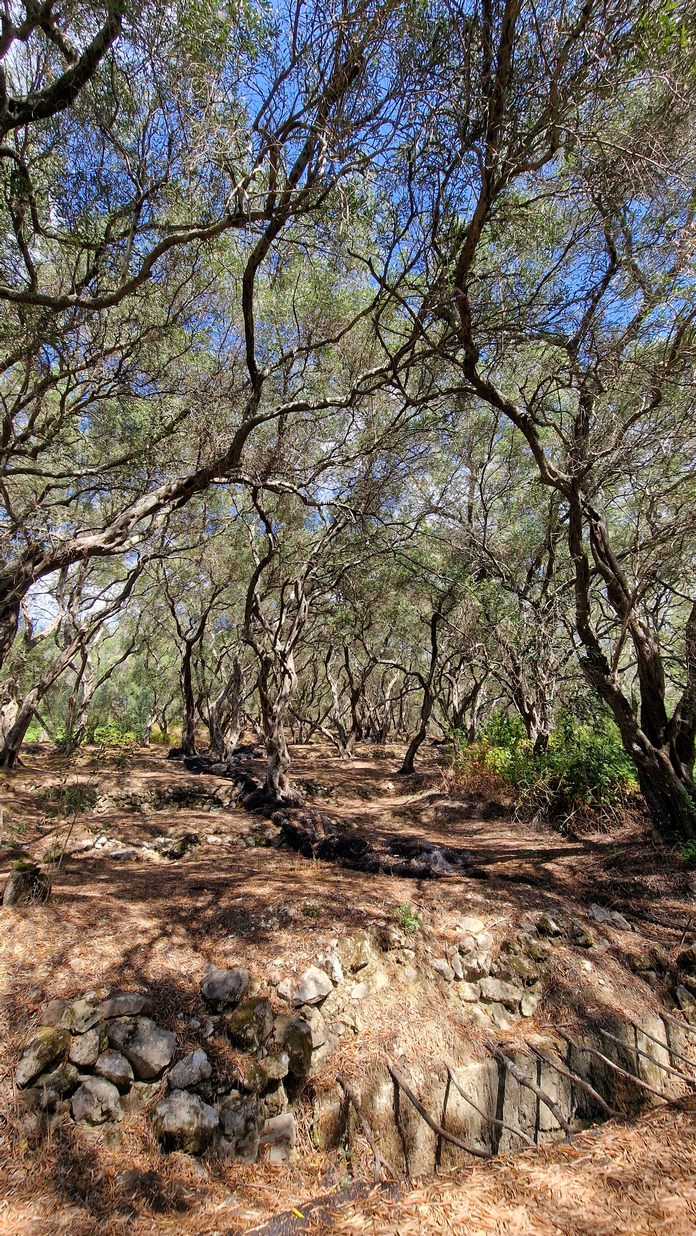
At moments, some of these beautiful villages almost felt like ghost villages. They were not abandoned, of course, but the empty streets, closed doors and complete silence created a strange atmosphere.
And yet, only a relatively short distance away, thousands of visitors were enjoying Corfu’s busy coastal resorts.
A Countryside That Made Us Think
There was another side to the journey that left us feeling slightly sad.
We passed many olive groves, fields and pieces of agricultural land that appeared to have received very little attention for some time.
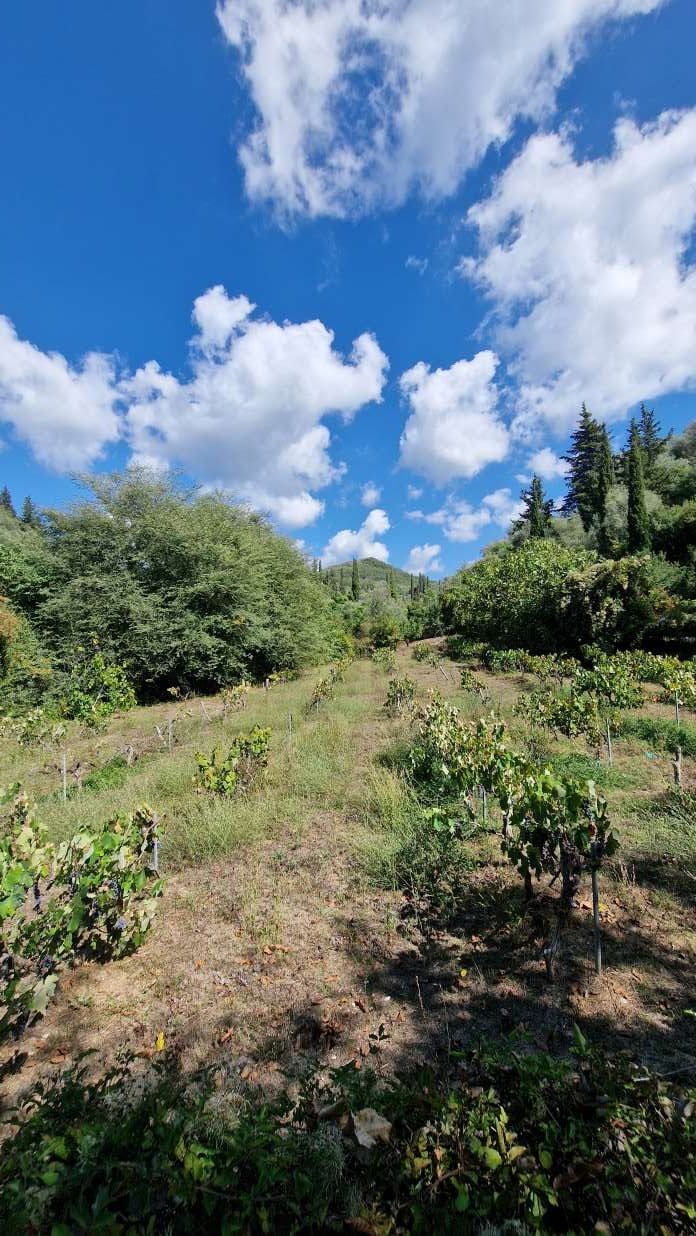
We obviously do not know the circumstances behind individual properties, so it would be unfair to make assumptions about why particular pieces of land are no longer cultivated.
But the overall impression made us think about how much life in Corfu has changed.
Tourism now provides a living for a huge number of island families, while traditional agriculture is clearly a much more difficult way to make a living than it once was. Perhaps there are not enough incentives for younger generations to continue working the land. Perhaps the income simply cannot compete with tourism.
Whatever the reasons, seeing so much beautiful and fertile countryside apparently underused was a little melancholic.
It also reminded us how important it is not to think of Corfu only in terms of hotels, beaches and restaurants. There is another island inland — one shaped by olive trees, farming, villages and generations of families who lived from the land.
Arriving in Sokraki
Eventually we reached Sokraki, a traditional mountain village in northern Corfu.
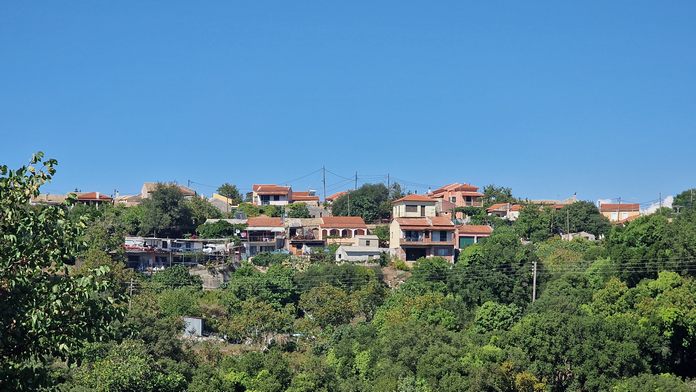
The village itself lies at around 440 metres above sea level, although the exact altitude naturally varies depending on where you are standing.
At the viewpoint where we stopped, my Geo Tracker was showing 471 metres above sea level.
And we could definitely feel the difference.
After the warmer air closer to the coast, it was noticeably cooler and fresher up there. There was a pleasant mountain breeze, and combined with the enormous landscape opening below us it felt as if we had travelled much farther from Roda than we actually had.
471 Metres and a View Worth the Whole Journey
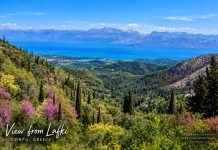
Then there was the view.
That alone was worth the entire trip.
We stood there looking across Corfu and simply did not want to leave.
We took photographs, moved a few metres, looked again, took more photographs and then stood there doing nothing except enjoying what was in front of us.
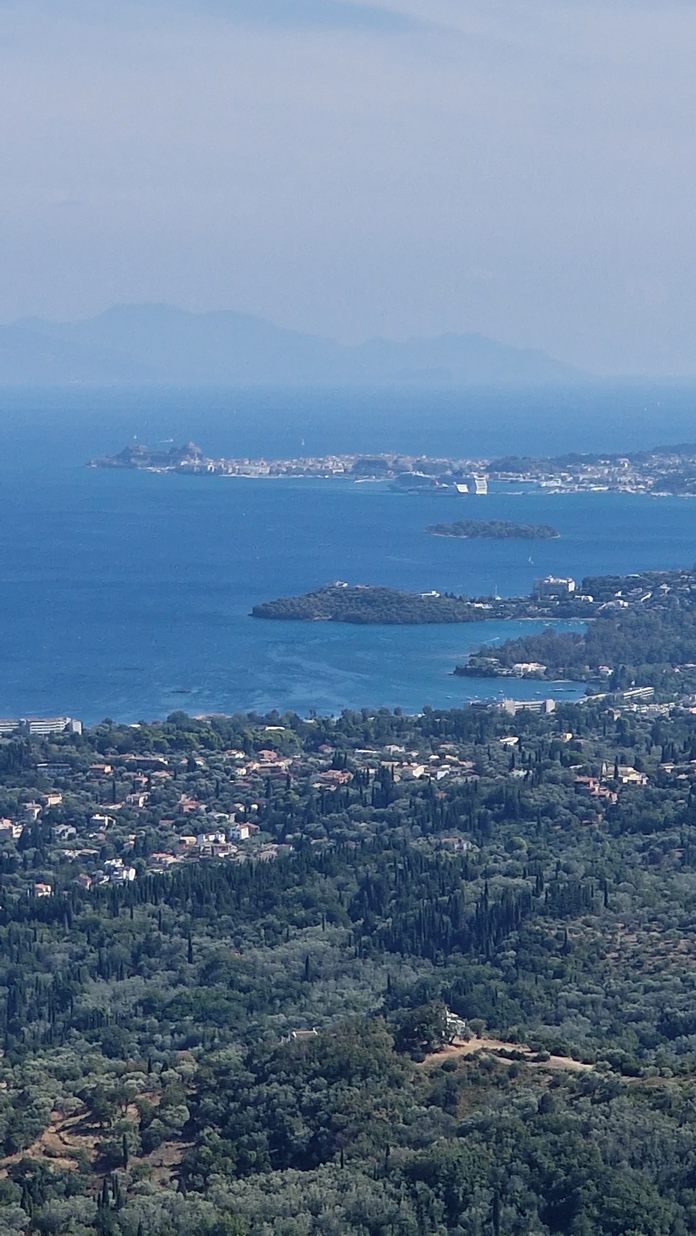
Sokraki’s position gives it extraordinary views in different directions. On clear days, from various parts of the village it is possible to look towards Corfu Town and the southern part of the island, while in the opposite direction the view reaches towards the Diapontia Islands.
This was the moment when a name came into my head: The Balcony of Corfu.
It is not an official nickname for the village. It is simply how Sokraki felt to me at that moment — a huge natural balcony hanging high above the island. For a few minutes I even wondered whether we should call it The Balcony of the Gods.
But I think The Balcony of Corfu describes it better.
Our Brief Stop at Sokraki Villas
We briefly pulled into the parking area at Sokraki Villas because the panorama from this side of the village was simply too good to ignore.
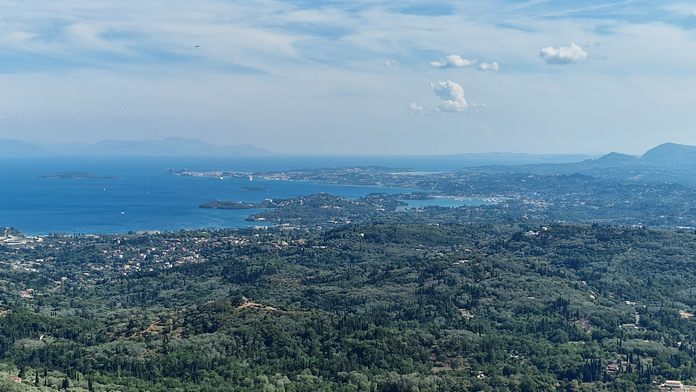
We noticed the sign saying that the parking area was intended for customers. We only stayed briefly to enjoy the view and take photographs because, unfortunately, we did not have enough time that afternoon to sit down for a drink or meal.
Next time, however, we definitely will.
The family-run Kapilio Tavern at Sokraki Villas is not restricted to guests staying at the accommodation. It also welcomes visitors to the village and serves traditional Greek and Corfiot dishes using local ingredients.
Considering the location and the view, next time we come to Sokraki we intend to experience it properly rather than rushing away.
Walking Through the Village
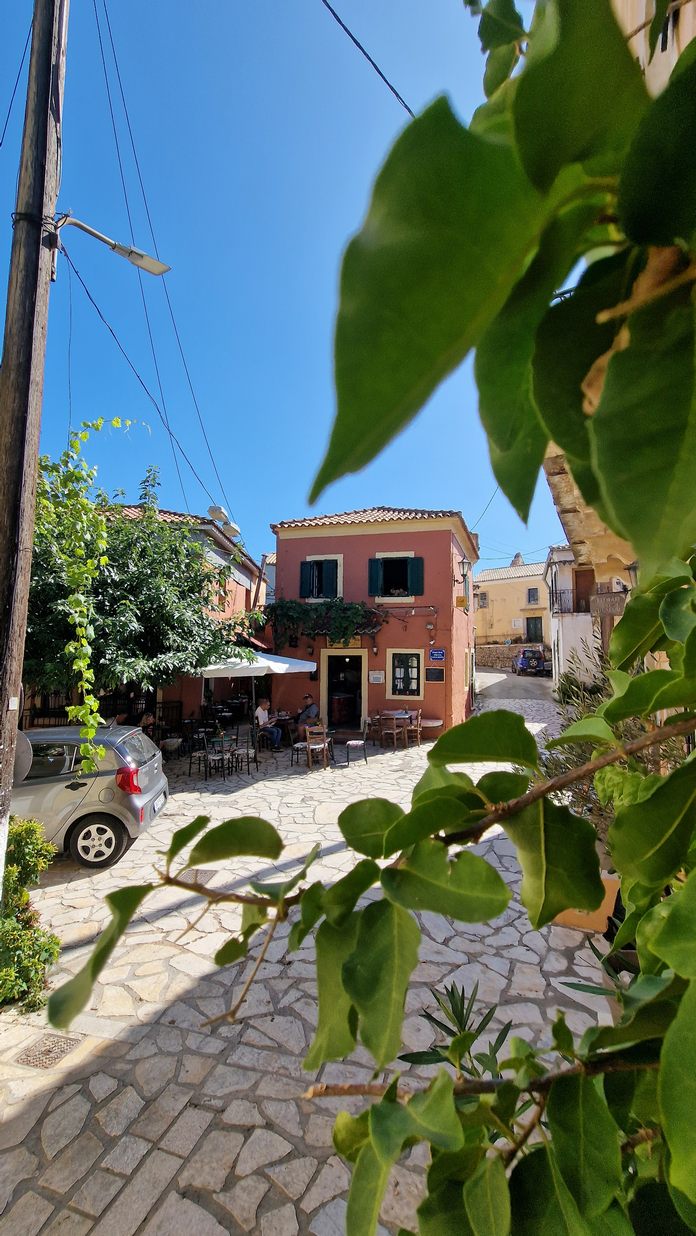
After enjoying the viewpoint, we went into the village itself and walked around its small central square and narrow streets.
This is where Sokraki becomes much more than simply a viewpoint.
Old stone houses, paved lanes, little squares and traditional buildings give the village an atmosphere that is increasingly difficult to find in the more developed coastal areas of Corfu.
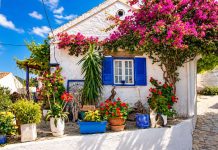
One of the things that immediately caught our attention was how colourful many of the houses were.
There were flowers everywhere — in pots, courtyards, balconies, entrances and along the village streets.
You could tell that people had taken pride in making their homes beautiful.
Walnut Trees, Conifers and Hanging Gourds
We were also surprised by the variety of vegetation.
We saw quite a few walnut trees, together with the familiar olive trees and cypresses of Corfu.
There were also tall conifer-like trees that looked almost like firs, something that seemed much more at home in a mountain landscape than on the Corfu most visitors know from the coast.
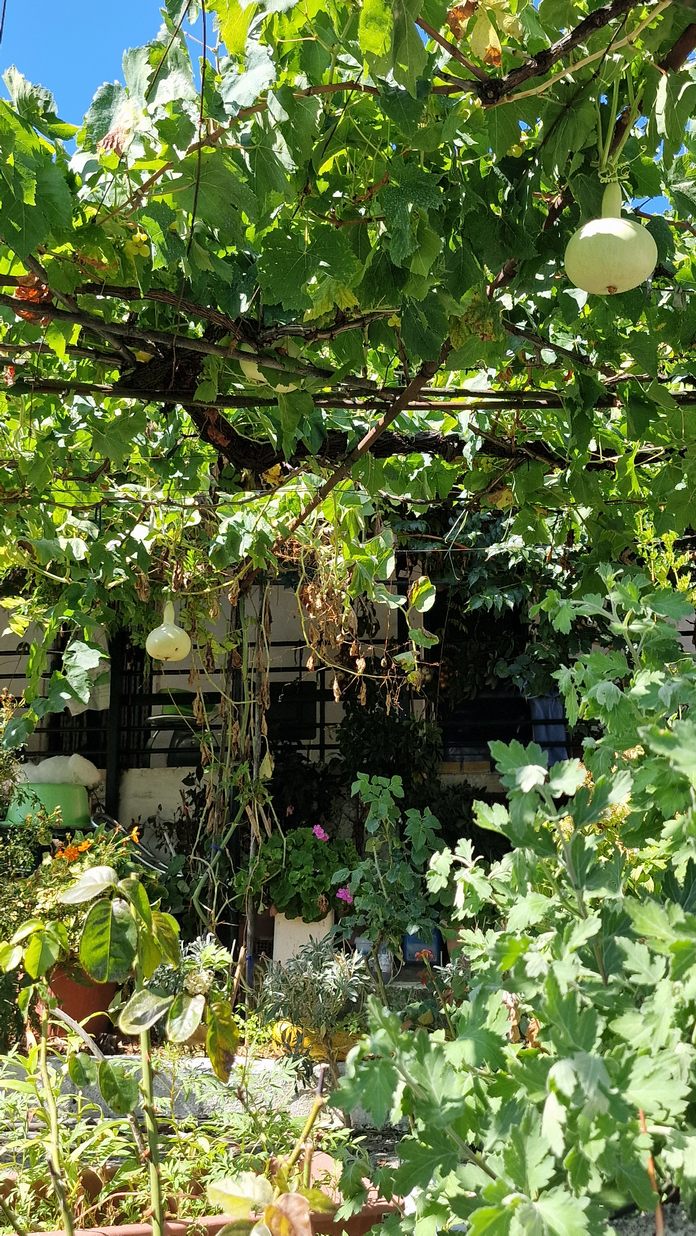
Then we noticed something else that immediately made us stop for a photograph: long gourds hanging from their vines.
These little discoveries may sound insignificant, but they are exactly the things that make walking through an old village enjoyable. You start noticing gardens, trees, old doors, flowers and details that you would completely miss if you simply drove through.
An Old Olive Mill Hidden Behind a Local Shop
One of our favourite discoveries was in the centre of Sokraki.
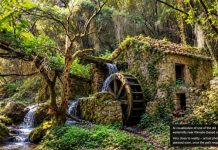
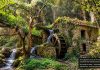
We entered a small shop selling local products and discovered that at the back of the building there was a beautifully preserved traditional olive mill.
This is the Lithari Olive Oil Museum.
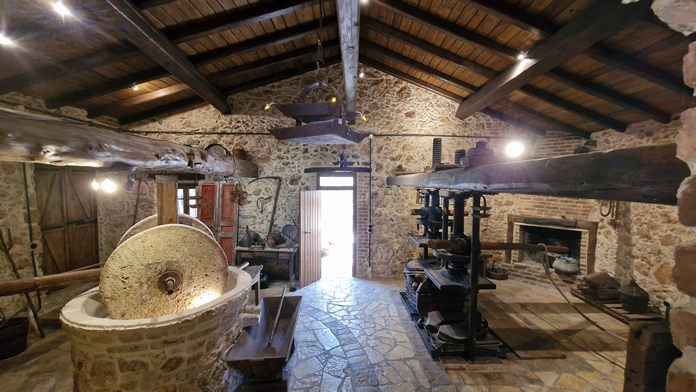
Inside, the enormous old stone millstones and traditional olive-processing equipment offer a glimpse into a time when producing olive oil was one of the most important activities in village life.
The large circular stones were used to crush the olives before the resulting paste went through the pressing process.
For us, this was particularly interesting because olive trees are so much a part of everyday Corfu scenery that it is easy to forget how much physical work and traditional machinery once went into producing the oil every family used.
The building itself formerly operated as an olive mill and today combines this part of the village’s agricultural history with local products and accommodation.
How Old Is Sokraki?
Sokraki has a remarkably long history.
The first historical reference commonly cited for the village dates to 1343, when Sokraki appears together with other villages of the area in connection with the construction of the Monastery of Pantokrator.
That means there is documented evidence of Sokraki going back more than 680 years, although the settlement itself may be considerably older.
The village has preserved much of its traditional architectural character, including stone houses, paved lanes, old olive mills and two small squares. Some of its churches date back to the 16th century.
Why Is It Called Sokraki?
Despite the similarity in English, the name has nothing to do with the ancient philosopher Socrates.
The generally accepted explanation connects the name with the old expression “Eso Korakion”, meaning the inner side of Mount Korakion.
Over time, the expression is believed to have evolved into the name we use today: Sokraki.
A Village That Inspired a Poet
We were clearly not the first people to be impressed by the landscape.
The Corfiot poet and politician Lorentzos Mavilis was inspired by Sokraki and dedicated a sonnet to the village.
After standing at the viewpoint ourselves, it is not difficult to understand why.
Where to Eat and Drink in Sokraki
Sokraki may be a small mountain village, but visitors do have places to stop for coffee, food and local flavours.
As mentioned above, Kapilio Tavern at Sokraki Villas serves traditional Greek and Corfiot dishes and is also open to visitors who are not staying at the villas.
Inside the village, Varzas is a traditional coffee shop and village meeting place where visitors can stop for drinks, snacks and food, while Emily’s Cafe is another established place for coffee and refreshments.
Opening days and hours can change according to season, so it is worth checking before making a special journey for a particular restaurant or cafe.
Can You Stay Overnight in Sokraki?
Yes. Although many people visit Sokraki as a short road trip, there are several small accommodation options for anyone who would rather experience the village after the day visitors have gone.
Besides Sokraki Villas, there is Lithari Suites in the village centre, in the same historic complex as the old olive mill, as well as smaller holiday homes such as Rafaela’s House Sokraki.
Staying here for a night or two would offer a completely different Corfu experience from staying beside the beach — particularly for walkers, photographers and anyone looking for peace, cooler mountain air and traditional village surroundings.
We Felt Lucky to Call Corfu Home
Somewhere during the afternoon, Spiros and I found ourselves saying more or less the same thing.
We felt incredibly lucky.
Tourists travel thousands of kilometres to see landscapes like this, while for us it was simply an afternoon drive from home.
And yet neither of us had been here before.
That was perhaps the biggest lesson of the day.
You can be born in Corfu, live here for decades and still discover roads, villages and landscapes that make you feel as though you are seeing your own island for the first time.
A Different Kind of Corfu Road Trip
Our trip to Sokraki was not about ticking attractions off a list.
It was a coffee in Roda, a drive through Klimatia, almost empty village streets, old olive groves, colourful flowers, walnut trees, hanging gourds, an unexpected traditional olive mill and finally a mountain viewpoint at 471 metres where neither of us wanted to leave.
There was happiness in the journey, but also a little sadness.
The quiet villages and apparently neglected fields made us think about how much the island has changed and how important it is to preserve the other Corfu — the inland Corfu that existed long before mass tourism arrived.
But above all, the day reminded us of something very simple.
Corfu still has the ability to surprise us.
Even those of us who call it home.
And as for Sokraki, I think I have found my own name for it.
The Balcony of Corfu.
We will return.

Discover the Best of Corfu!
Get local events, travel tips and important Corfu updates delivered straight to your inbox.