Deep in the green hills of northern Corfu, near the small village of Klimatia, a recently documented waterfall has revealed another side of the island that most visitors never see. Hidden among dense vegetation, old paths and the ruins of traditional watermills, this is a landscape that feels far removed from Corfu’s famous beaches.
But the waterfall is only part of the story. Around Klimatia you can discover forgotten watermills and millers’ houses, an old mountain monastery, caves and an enormous area of almost impenetrable woodland known locally as the Longos tou Dimogianni. It is one of those corners of Corfu where nature, history and local stories seem to overlap.
A newly documented waterfall in northern Corfu
In June 2026, reports emerged about a previously little-known waterfall discovered during local exploration in the wider Klimatia area of northern Corfu.
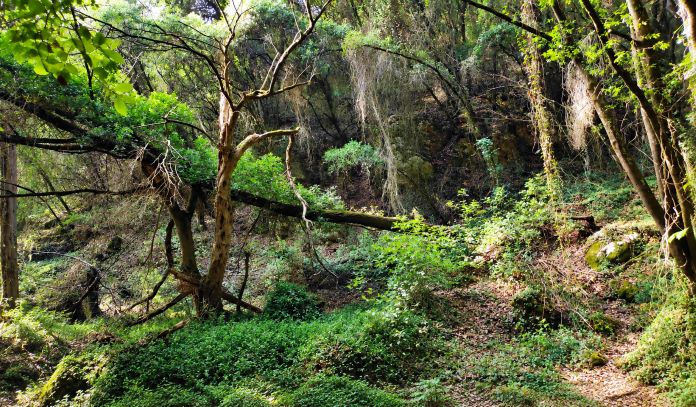
The waterfall is reported to be approximately six metres high. Water drops into a natural pool at its base which has been reported to reach almost three metres in depth.
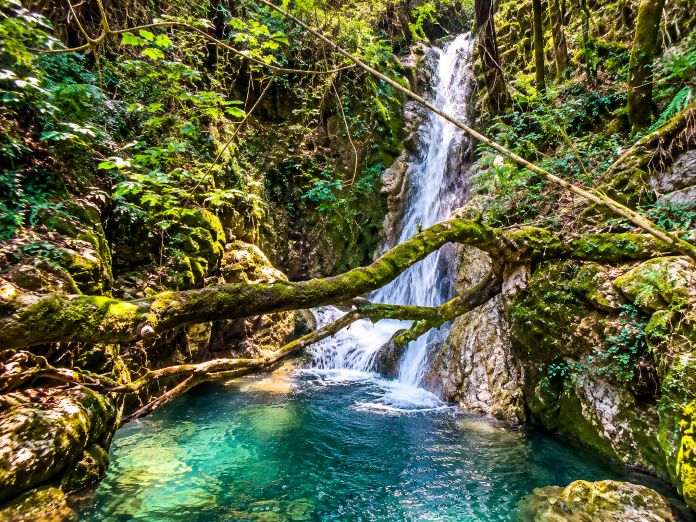
The surrounding landscape is covered by thick vegetation and remained largely undisturbed, helping explain why such an impressive natural feature could remain virtually unknown outside the local area for so long.
Even more interestingly, exploration along the watercourse revealed a second, smaller waterfall nearby, suggesting that there may still be considerably more to document in this little-explored landscape.
The forgotten watermills of Klimatia
What makes this discovery particularly interesting is not simply the waterfall itself.
The water continues through an historic landscape of old watermills that once played an important role in the economy of Klimatia and the surrounding villages.
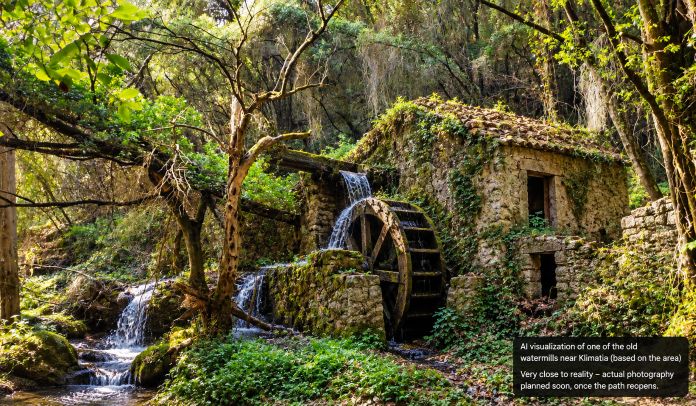
One recent report refers to a network of eight traditional watermills along the watercourse. Other local documentation confirms at least five watermills in the area, so the exact historical number still deserves further research.
These stone-built mills used the natural flow of water to turn their machinery and grind grain for local communities. During the 18th and 19th centuries, watermills were an important part of rural Corfu’s economy.
Today the machinery has fallen silent.
The mills survive mainly as ruins among the vegetation, together with the remains of stone houses where the millers and their families once lived.
Walking from Pano Vrysi into another Corfu
There is an old route through this landscape known as the trail from the bridge of Pano Vrysi to the watermills and the houses of the millers.
The route follows the Lagkades path beneath the picturesque old bridge of Pano Vrysi and continues through olive groves and increasingly dense woodland.
Eventually the path reaches the abandoned watermills and the ruins of the homes that developed around them.
This is exactly the type of Corfu walk I find fascinating. There is no ticket office and no organised tourist attraction waiting at the end. Instead, you are walking through the remains of the everyday life of people who lived and worked here generations ago.
Local authorities and the community have already discussed protecting and improving this cultural and environmental route while preserving its natural character.
Watch the waterfall
You can get a much better idea of the landscape and the newly documented waterfall in the following video from Kerkyraiki Apopsi:
Watch the original video on YouTube
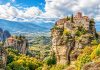
Holy Trinity Monastery high above Klimatia
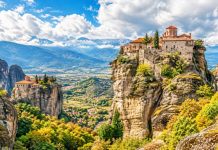
The mountain above Klimatia hides another remarkable place: the Holy Trinity Monastery of Klimatia.
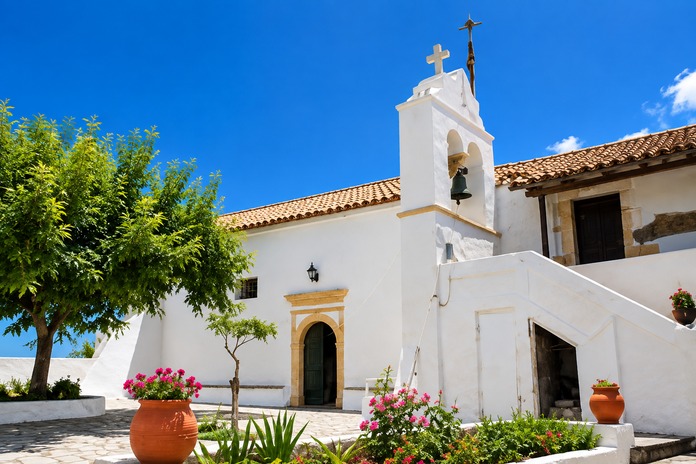
The monastery stands at an altitude of approximately 450 metres, surrounded by the forests and mountains of northern Corfu.
Its main church dates back to the 15th century. Particularly interesting are the surviving wall paintings, which have been dated to around 1672, while icons of the iconostasis date from the 19th century.
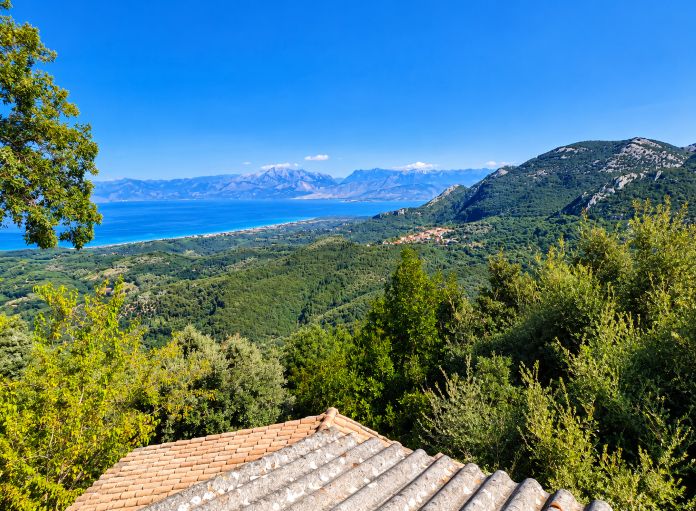
The monastery celebrates on the Monday of the Holy Spirit and its isolated location gives visitors a completely different impression of Corfu from the busy resorts of the northern coast.
See Holy Trinity Monastery of Klimatia on Google Maps
The mysterious forest behind the monastery
Behind the monastery stretches a large and very dense forest known locally as Longos tou Dimogianni.
The word longos is difficult to translate perfectly into English in this context. It describes a dense area of woodland or thick forest, often with heavy undergrowth that can make walking through it extremely difficult.
This is not a manicured forest with marked tourist paths. Parts of the landscape are wild, overgrown and difficult to penetrate.
I first heard about Longos tou Dimogianni from my friend Spyros from Rachtades, who knew the area from years ago when he used to go hunting there.
He described it to me as a genuinely wild part of northern Corfu, very different from the countryside most visitors experience from the road.
Wild boars in the forests of Corfu
One of the stories Spyros told me initially sounded surprising: wild boars had been found in this part of Corfu.
But wild boars on Corfu are not simply a local legend.
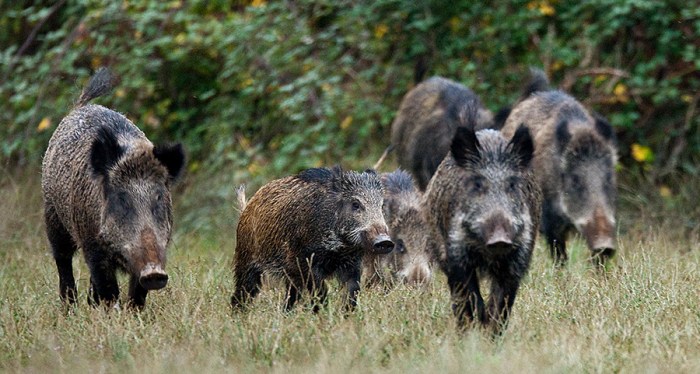
Research into the island’s larger mammals has documented that wild boars have reached Corfu by swimming across the Corfu Channel from the nearby mainland. Historical reports include animals crossing from the Butrint region of Albania, while photographic evidence has also documented individual wild boars entering Corfu from the sea.
There is another part to the story. Some wild boars present on the island are believed to have originated from animals kept in captivity or deliberately released, with some subsequently escaping and reproducing.
Corfu’s narrow separation from the Albanian and Greek mainland makes these natural crossings less extraordinary than they first sound. Wild boars are strong swimmers, and the shortest sea crossing between northeastern Corfu and the Albanian coast is only a few kilometres.
The story of the cave and the wild-boar bones
Spyros also told me another intriguing story from the area.
According to what he remembers, a cave in this wider forested landscape – now closed – was once found to contain wild-boar bones.
I have not yet found an archaeological or scientific publication confirming this particular discovery, so I prefer to present it for what it currently is: an interesting piece of local oral history rather than an established archaeological fact.
Stories like this are one of the reasons I enjoy speaking with people who have spent their lives exploring Corfu’s countryside. Sometimes local knowledge points towards places and stories that barely appear online.
Anthropograva – another secret beneath Klimatia
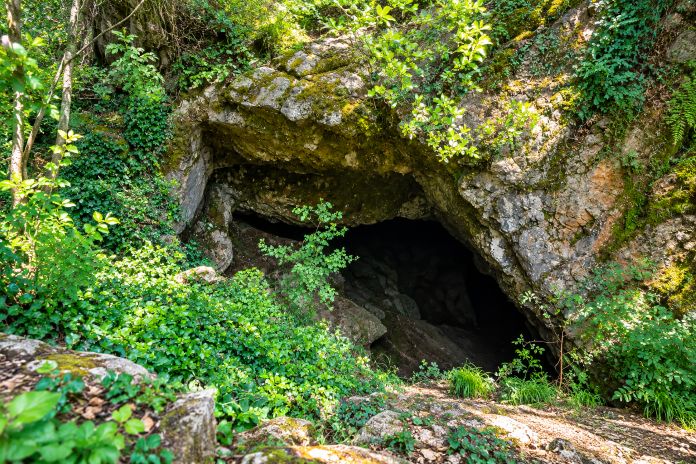
There is, however, one cave near Klimatia that has been much more extensively documented: Anthropograva.
Located north of Loukios Hill at an altitude of approximately 270 metres and relatively close to the Holy Trinity Monastery, Anthropograva is one of the most fascinating natural monuments in northern Corfu.
The cave covers approximately 1,390 square metres, with around 500 square metres described as accessible. Inside are stalactites, stalagmites and large rock formations whose shapes have inspired comparisons with human and animal figures.
The cave has recently attracted renewed interest from the Municipality of North Corfu and has been included in environmental initiatives aimed at highlighting and protecting the area’s natural heritage.
For me, its significance becomes even greater when viewed as part of the wider Klimatia landscape: caves, springs, streams, waterfalls and watermills are all pieces of the same story shaped by water and limestone over centuries.
Klimatia village itself
Klimatia should not simply be treated as the starting point for these excursions.
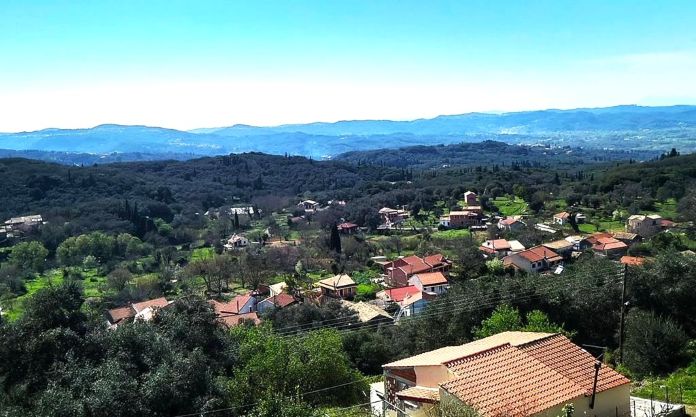
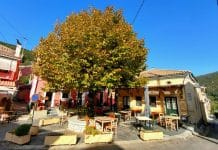
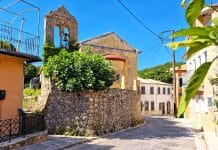
The village stands at approximately 220 metres above sea level and has a population of only a few hundred residents. Walking through its narrow streets you will find old stone houses, traditional architecture and plenty of reminders that this is still very much a living Corfiot village.
From Corfu Town it is approximately 31 kilometres by road. Roda is around 8 kilometres away and Sidari around 14 kilometres, making Klimatia surprisingly easy to combine with a day exploring northern Corfu.
Other interesting places near Klimatia
If you are already exploring this part of northern Corfu, there are several other places worth considering.
Kyprianades Waterfall: Another little-known seasonal waterfall hidden in the countryside of northern Corfu.
Nymfes Waterfalls: The better-known waterfalls near the traditional village of Nymfes are particularly attractive after periods of rainfall.
Lithari Olive Oil Museum: Located at Sokraki, this small museum offers another look into the traditional agricultural life of Corfu.
Corfu Donkey Rescue: A sanctuary caring for rescued and elderly donkeys in the countryside near Doukades.
Roda and the northern coast: After spending several hours walking through forests and abandoned watermills, you can reach the beaches and restaurants of Roda in only a short drive.
A side of Corfu we are still discovering
What fascinates me most about Klimatia is how much appears to be concentrated within such a small area.
A waterfall that only recently attracted wider attention. A second waterfall hidden further along the stream. Forgotten watermills and abandoned millers’ houses. A centuries-old monastery standing high above the village. Dense forest, caves and stories passed from one generation to another.
It is easy to think that an island visited by millions of people must have already revealed all its secrets.
Places like Klimatia remind me that this simply isn’t true.
There are still paths in Corfu that most visitors never walk, ruins hidden beneath vegetation and stories that survive mainly because someone local still remembers them.
And those are often the places I find most interesting.
Have you explored Klimatia, its watermills or the forests around the Holy Trinity Monastery? If you know an old story about this area – particularly about Longos tou Dimogianni, its caves or the old watermills – I would love to hear it in the comments.
Discover the Best of Corfu!
Get local events, travel tips and important Corfu updates delivered straight to your inbox.