It is early September in Corfu, the intense heat of July and August is beginning to ease, and today I decided it was the perfect time to finally visit Doukades. I had heard plenty about this traditional village and had driven past it many times on my way towards Paleokastritsa, but somehow I had never stopped to properly explore it.

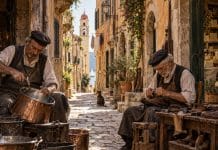
So today I changed that. I parked the car, took my camera and started walking through the village. I photographed the old houses and narrow streets, spent some time in the beautiful central square and, most importantly, talked with some of the local people.
We spoke about the history of their village, its old buildings and everyday life here. I sat with them, had a cold tsitsibira – Corfu’s traditional ginger beer – and listened to a few of their stories.
What follows is a mixture of what I saw myself, what I learned from the people I met and some of the history I researched afterwards.
A Corfu village with more than 400 years of recorded history
Doukades is located in northwestern Corfu, a short drive from Paleokastritsa, but the atmosphere is completely different from the busy coastal resort.
The village is surrounded by green hills, woodland and seemingly endless olive trees. It has been officially designated a traditional settlement, and once you leave the main road and start exploring on foot, it is easy to understand why.
The earliest known written reference to Doukades dates to 1616. According to one explanation, the name of the village probably came from some of its earliest inhabitants, who carried the surname Doukas.
More than four centuries later, Doukades remains a living Corfiot village rather than somewhere preserved purely for tourists. That was one of the things I liked most about it.
The beautiful village square
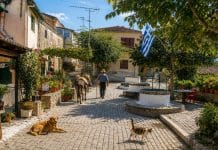
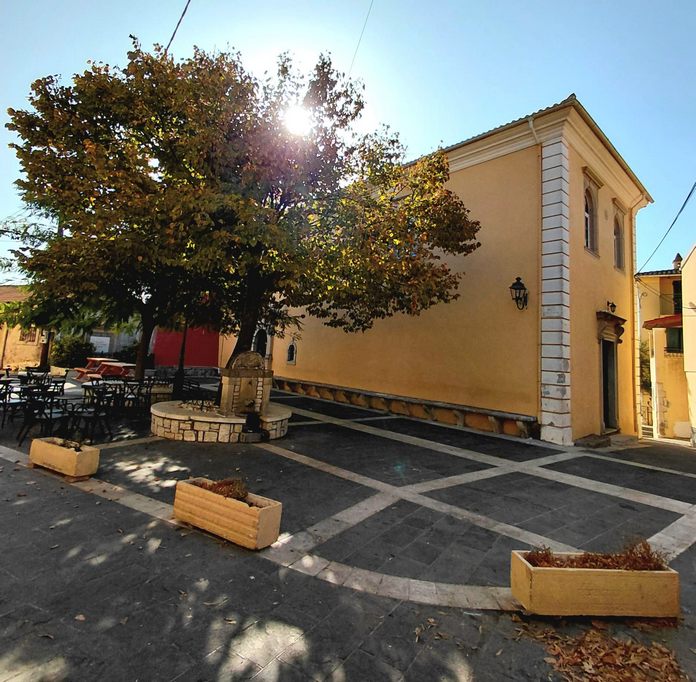
The heart of Doukades is its stone-paved square. Old houses surround it, with traditional tavernas and cafés putting their tables outside beneath the trees.
This is where I would recommend slowing down rather than simply walking through, taking a few photographs and leaving.
Sit down, order something, have a tsitsibira or some local food and watch village life for a while. Places like Doukades make much more sense when you give them time.
Panagia Mesochoritissa
At the centre of the village stands the church of Panagia Mesochoritissa. Even its name tells you something about its location: it is essentially the church in the middle of the village.
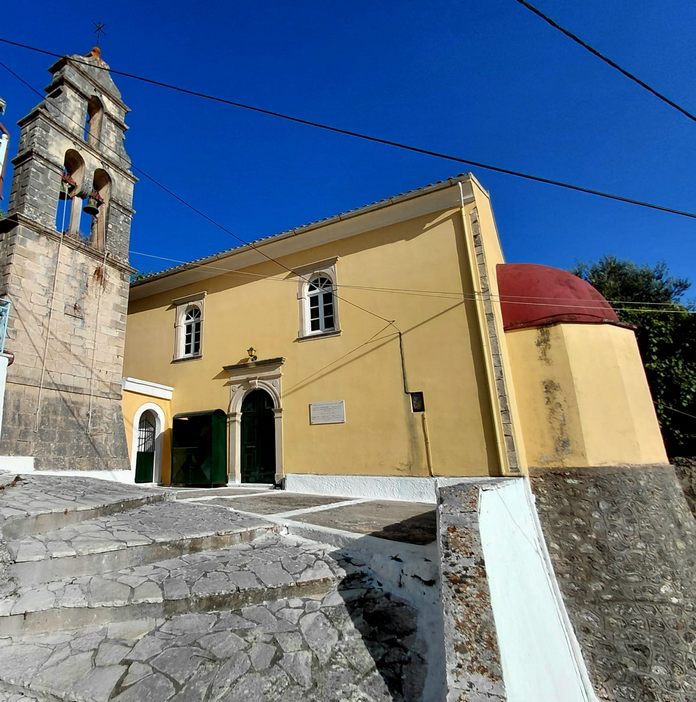
The winding road through Doukades develops around this central part of the settlement, with small lanes leading away towards older houses and quieter corners.
The historic Theotokis Mansion
One building in particular surprised me.
The restored stone mansion of the Theotokis family is one of the historic buildings for which Doukades is known. The Theotokis family is one of Corfu’s oldest and most prominent families, with generations of politicians, landowners and public figures connected with the island.

Gate of Theotokis Mansion Doukades.
The residence itself carries a fascinating history. The property remained within the Theotokis family through generations and was associated with figures including Michail Theotokis, who served as Mayor of Corfu, and Georgios Theotokis, who served several times as Prime Minister of Greece.
It is a reminder that villages such as Doukades were not simply agricultural settlements. Some of Corfu’s most influential families maintained substantial country residences here, leaving behind an aristocratic layer of village history that is still visible today.
From the Theotokis Mansion to the Theotoky Estate
The Theotokis name also leads us beyond Doukades and into the nearby Ropa Valley.
The Theotoky Estate is a historic family agricultural estate whose story spans six generations. Family archives record land purchases in the Ropa Valley going back to the period of Ioannis Vaptistis Theotokis, who lived from 1778 to 1865. The land was already being used for vineyards, olive trees, corn, oats and vegetables.
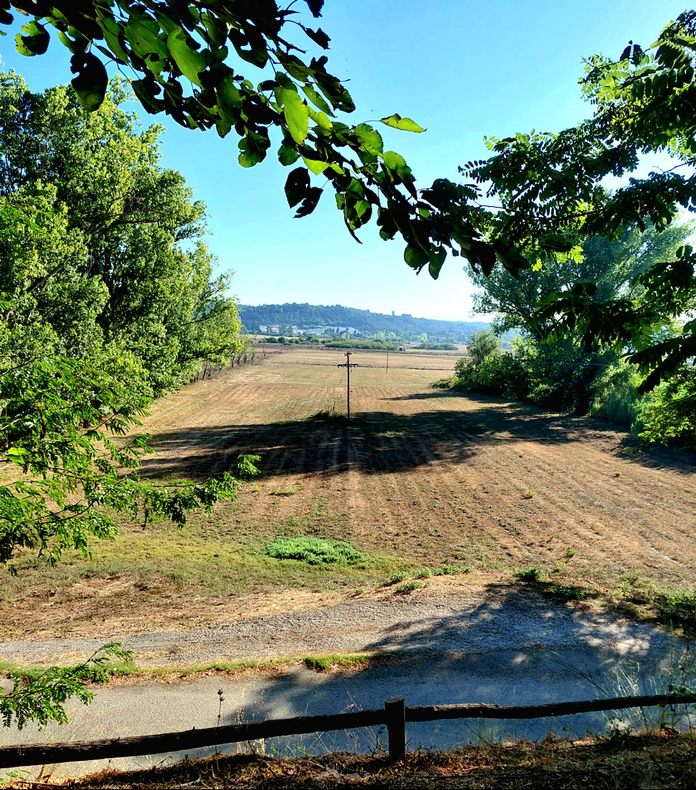
A major part of the estate was acquired in 1878 by Georgios Theotokis, who later became Prime Minister of Greece. Subsequent generations continued its agricultural tradition, with particular emphasis on wine and olive oil.
During the 20th century, Georges Theotoky and his wife Claudia modernised the winery while maintaining the traditional character of the estate. Today, Theotoky Estate remains particularly associated with estate-produced wine and olive oil.
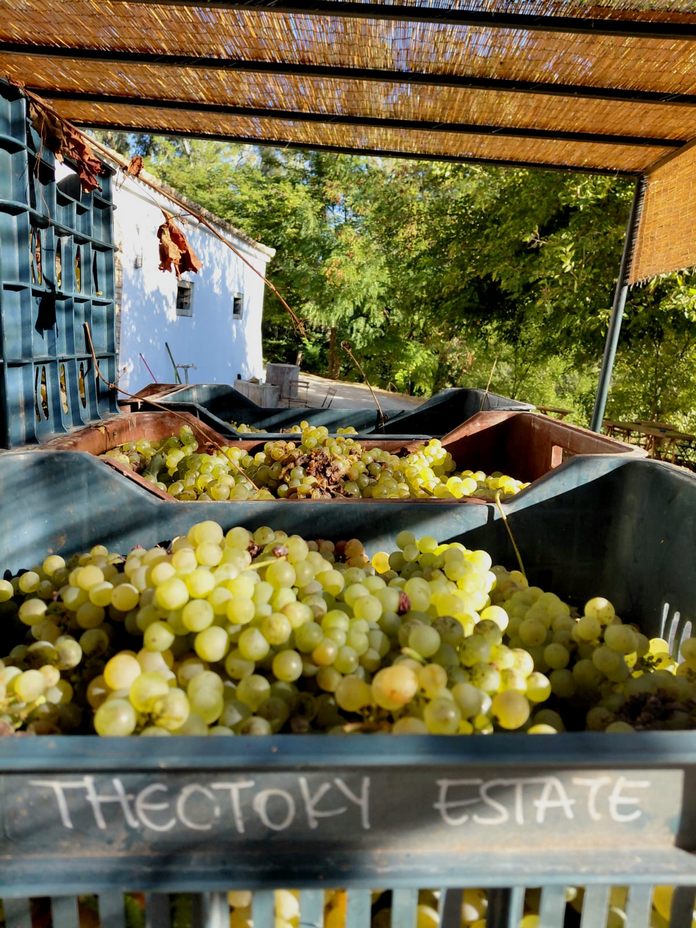
For visitors interested in the countryside around Doukades, this makes a fascinating addition to the area: within a relatively small part of Corfu you can connect the story of an old aristocratic village residence with generations of agricultural life in the Ropa Valley.
The Venetian-style Sagrado
Another unusual feature worth looking for in Doukades is the old Venetian-style sagrado associated with the Kouartanos family.
It is the sort of architectural detail that is very easy to walk past without realising that there is a story behind it.
This is why I recommend exploring Doukades slowly and occasionally looking away from the main square. Some of its most interesting details are hidden between the houses.
The old school at the entrance to Doukades
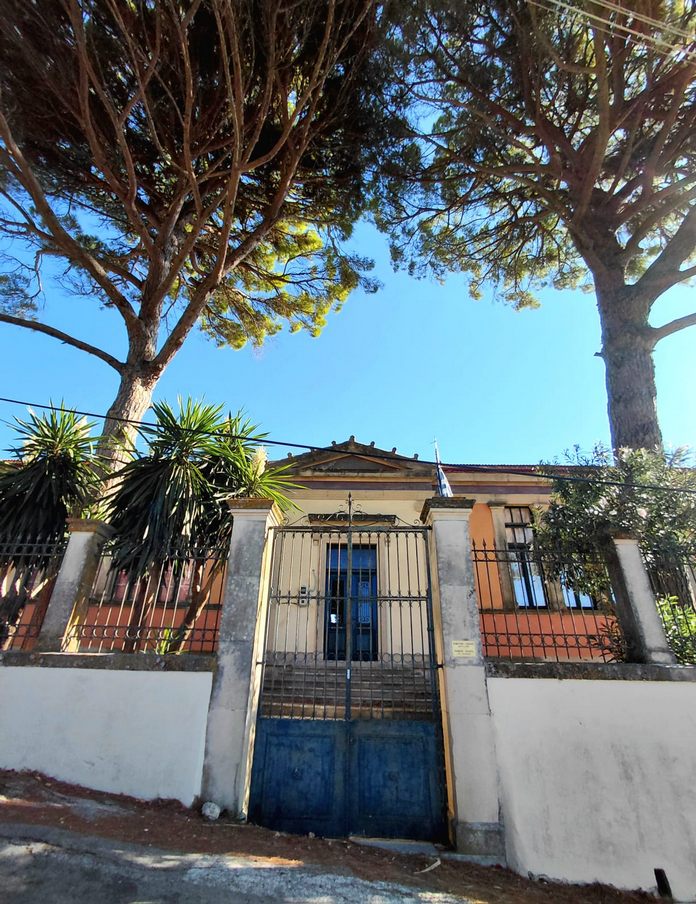
Another building that stands out is the old elementary school near the entrance to the village.
The historic school is architecturally very different from a modern Greek school building and forms an important part of the traditional character of Doukades.
Buildings like this are among the things I enjoy finding when visiting Corfu’s inland villages. They tell you much more about how communities developed than a modern tourist attraction ever could.
Agios Symeon – the little chapel above the cliffs
If there is one place outside the village itself that I would add to a visit to Doukades, it is the small chapel of Agios Symeon, locally also known as Ai Symios.
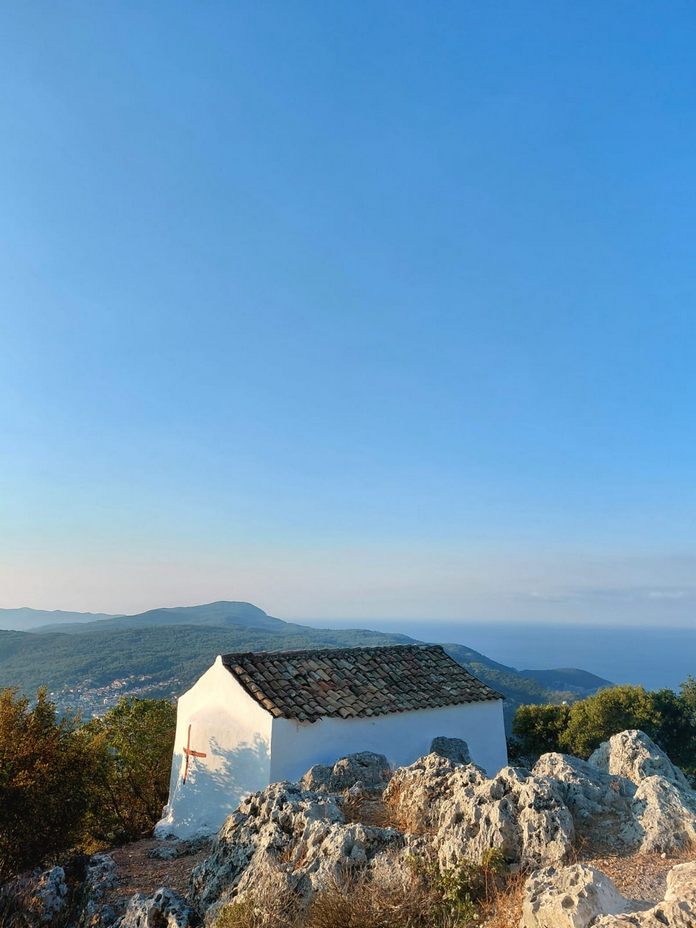
The chapel occupies an extraordinary position southwest of Doukades, at an altitude of around 319 metres. It seems to balance on the edge of the steep southeastern side of Kratsalo, in an area known as Kokkinogrema.
From here the landscape suddenly opens below you. The Ropa Valley stretches across the interior of the island, while the viewpoint takes in much of central and western Corfu and even parts of the eastern side.
Seen from below and from a distance, the tiny chapel sitting above the precipice has even been compared to a miniature version of Meteora.
A chapel surrounded by legends
Agios Symeon is more than simply a beautiful viewpoint.
Its exact age is uncertain, but we know that the chapel already existed before 1753. In a list of Corfu’s churches compiled that year, it appears as the “Prophet Symeon on the mountain”.
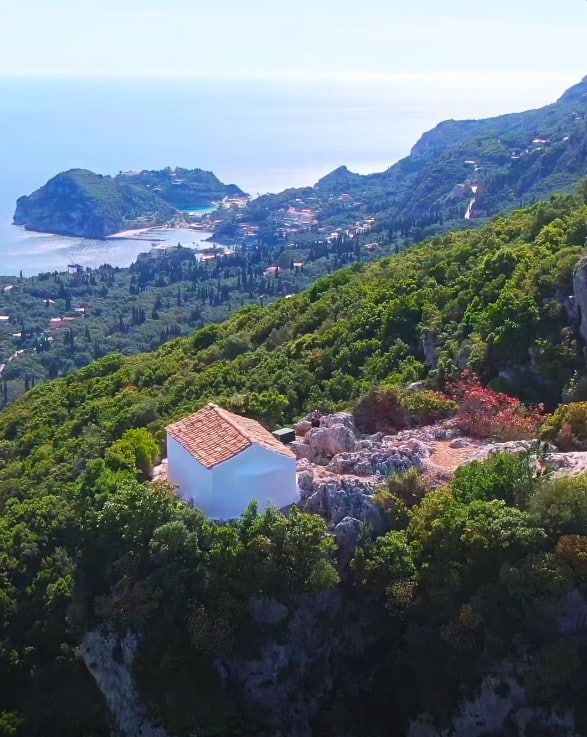
There are also local traditions surrounding its origin. One particularly intriguing story connects the chapel with the lost settlement of Mamali, although this has not been historically established.
The chapel is dedicated to the Prophet Symeon. Its isolated position, the precipice immediately below it and the silence of the surrounding countryside give this place a completely different atmosphere from the busy coastal attractions only a few kilometres away.
Walking from Doukades towards Agios Symeon
Agios Symeon can be approached from the Doukades area, with the final route following countryside tracks towards Kratsalo.
It is not the kind of place where I would recommend arriving in a hurry. The climb can be tiring, particularly in hot weather, but this is precisely why early September, spring or autumn are much better times to explore it than the hottest weeks of July and August.
Wear proper walking shoes, carry water and allow yourself enough time. The combination of the isolated chapel, the cliffs and the panoramic view over the Ropa Valley makes the effort worthwhile.
Eating in Doukades
Doukades has become particularly well known for the traditional tavernas around its square.
You will find places serving Greek and Corfiot dishes, including well-known village restaurants such as Taverna Elizabeth and O Doukas. Rather than rushing back towards the tourist resorts for dinner, I think staying in the village for a meal is part of the experience.
And if you have never tried tsitsibira, this is as good a place as any to order one. The traditional Corfiot ginger drink is refreshing, slightly spicy and particularly good after walking around the village on a warm day.
What else can you see near Doukades?
Doukades is in a very useful position for exploring this part of Corfu, so I would combine the village with one or two nearby places rather than making it a quick stop.
Theotoky Estate: Head into the Ropa Valley to discover another chapter in the long history of the Theotokis family, this time through vineyards, olive groves, wine and olive-oil production.
Paleokastritsa: One of Corfu’s most famous coastal areas is only a short drive away. You can swim, visit the monastery or take one of the small boats to explore the sea caves.
Angelokastro: One of the island’s most spectacular historic sites. The Byzantine fortress sits high above the northwestern coastline and offers extraordinary views.
Corfu Donkey Rescue: The sanctuary is very close to Doukades and looks after rescued and elderly donkeys. It can easily be combined with a visit to the village.
Liapades: Another traditional village nearby, with access to some beautiful small bays and beaches.
Ropa Valley: Instead of immediately returning to the coast, drive through Corfu’s green interior and discover a completely different side of the island.


Is Doukades worth visiting?
After finally stopping here instead of simply driving past, my answer is definitely yes.
Doukades doesn’t need a huge attraction to make it interesting. The attraction is the village itself: its square, old stone houses, historic buildings, surrounding countryside and the people who still live here.
But once you add the extraordinary location of Agios Symeon, the history of the Theotokis family and the nearby Ropa Valley, you realise there is considerably more to discover here than first meets the eye.
I particularly enjoyed being able to sit down, drink a tsitsibira and talk with local people rather than feeling that I was visiting somewhere created especially for tourists.
If you are staying around Paleokastritsa, Liapades or northwestern Corfu, I recommend putting aside at least a couple of hours for Doukades. If you add Agios Symeon, lunch in the square or a visit to the surrounding countryside, it can easily become a half-day excursion.
And if, like me, you have driven past the turn for Doukades many times without stopping, perhaps next time you should turn off the main road and see what you’ve been missing.
Have you visited Doukades or walked up to Agios Symeon? Do you know an old story about the village that I haven’t mentioned? Share your experience, memories or local tips in the comments below. I would especially love to hear from people who live in Doukades or have family connections with the village.
Discover the Best of Corfu!
Get local events, travel tips and important Corfu updates delivered straight to your inbox.