Long before tourism transformed Corfu, island life depended on people who could make, repair, carry, collect and improvise almost everything by hand. Tinsmiths, tailors, cobblers, carpenters, travelling merchants, midwives, olive pickers, basket makers, horse-cart drivers and even photographers moving between villages were all part of everyday Corfu. Some of these traditions survive. Others have almost completely disappeared.
When we talk about old Corfu, we usually think of Venetian buildings, traditional villages, enormous olive trees and faded black-and-white photographs.
But behind those photographs was another Corfu.
It was an island where very little was thrown away, almost everything could be repaired, people travelled much less than today and many villages had to be almost self-sufficient.
There was no supermarket around the corner, no van delivering parcels to your door, no mobile phone to call a taxi, and certainly no taking a broken household item to the recycling bin and buying another one the following afternoon.
Instead, there were craftsmen.
There were travelling merchants. There were women who walked to other villages to collect olives. There were men transporting everything from barrels of wine to household furniture behind a horse. There were village midwives called when a woman was ready to give birth.
Growing up in Corfu, I still remember traces of this world myself. Some of these professions were already disappearing when I was a child, while others survived in the villages for much longer.
Today they reveal a fascinating side of authentic Corfu that existed long before mass tourism arrived.
Soap Makers: A Corfiot Craft That Never Completely Disappeared
Perhaps the most remarkable surviving example of old Corfu craftsmanship is traditional soap making.
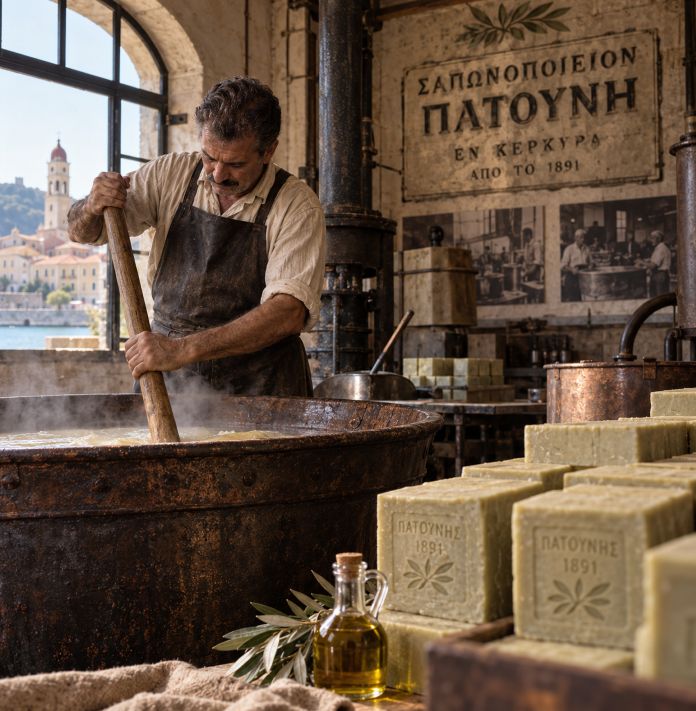
The historic Patounis Soap Factory has operated in Corfu Town since 1891, continuing a family tradition that stretches even further back.
The soap is still produced using traditional techniques and olive products, with the mixture cooked in large cauldrons much as it was generations ago.
This is not simply a reconstructed attraction created for visitors. It is a genuine working connection with Corfu’s industrial past.
The historic factory building and equipment have been protected as part of Greece’s industrial heritage, while the traditional soap-making knowledge of the Patounis family has also been included in Greece’s National Inventory of Intangible Cultural Heritage.
Visitors today can therefore see one of the increasingly rare cases where an old Corfiot profession did not become merely a museum exhibit.
Stagkopiniates: The Travelling Tinsmiths
One of the professions that has almost disappeared from memory was that of the stagkopiniatis, or tinsmith.
The name is connected with the Italian word stagno, meaning tin, another small reminder of the Venetian and Italian influence on the Corfiot dialect.
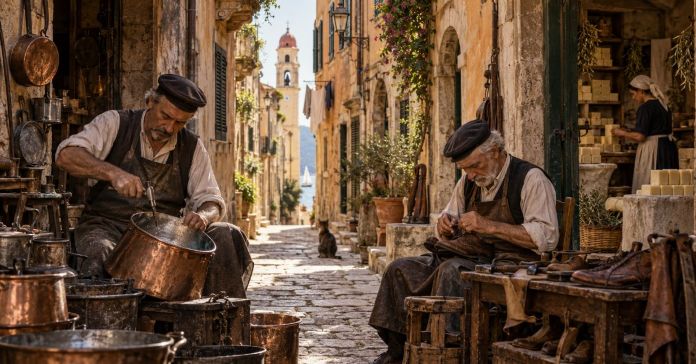
Copper cooking pots were once valuable household possessions.
When their protective inner surface became worn, people did not throw them away.
The tinsmith cleaned the copper vessel and coated its inside with tin, a process known in Greek as ganoma.
This allowed a pot or pan to remain in use for many more years.
Some tinsmiths worked from small workshops, while others travelled between neighbourhoods and villages looking for customers.
Their profession perfectly represents the philosophy of old Corfu: repair it, reuse it and make it last.
The Village Cobbler
The same rule applied to shoes.
The traditional tsagkaris, or cobbler, was an important craftsman both in Corfu Town and in the villages.
Shoes cost money and families expected them to last.
A damaged sole, worn heel or torn piece of leather was not automatically a reason to buy another pair. You went to the cobbler.
He repaired soles, heels and leather and could sometimes give an apparently finished pair of shoes several more years of life.
Before cheap mass-produced footwear became available, the cobbler was one of those small village professions that almost every community needed.
Tailors and Seamstresses
Clothing followed exactly the same pattern.
Before ready-made clothes filled shops, the tailor was an essential part of town and village life.
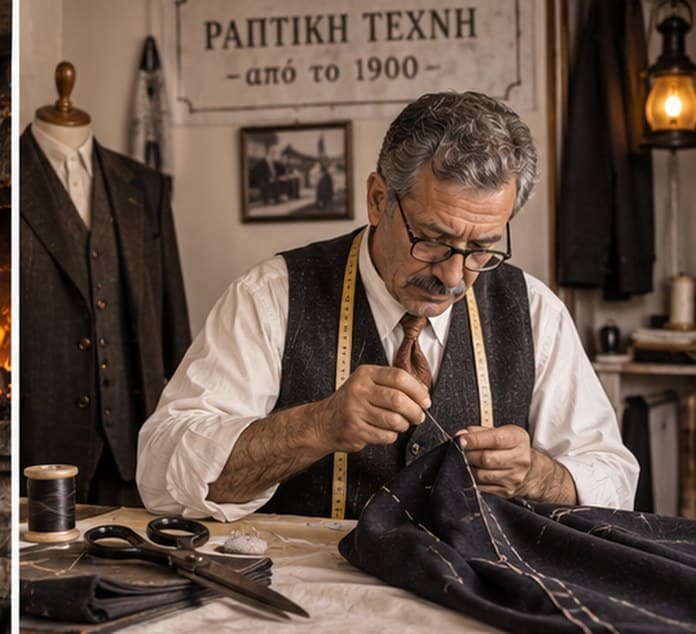
Traditional male tailors measured their customers and made or altered trousers, jackets, shirts and suits.
Women’s clothing was often the work of a seamstress or modistra, who could produce dresses, everyday clothing and even bridal gowns. The profession required far more than simply operating a sewing machine.
The tailor had to understand fabrics, take precise measurements, create patterns and adapt a garment to an individual body.
Good clothes were cared for, altered as bodies changed and sometimes handed from one member of the family to another.
Old records of Corfu’s organised workforce around the end of the 19th century include tailors among the island’s established trades.
Carpenters and Joiners: The Men Behind the Corfiot House
The maragkos, or carpenter, was another indispensable craftsman.
In a traditional Corfiot house, an extraordinary amount of what surrounded a family had been made locally.
Doors, shutters, tables, cupboards, chairs, beds, agricultural implements and many smaller household items all required somebody who understood wood. Corfu’s historical records mention carpenters among the principal trades operating on the island during the early 19th century.
Furniture-making workshops later became another established part of Corfu’s small-scale manufacturing economy.
Even today, when you walk through an old village and see enormous wooden entrance doors or weathered shutters fitted perfectly into irregular stone walls, it is worth remembering that somebody made each one individually.
Blacksmiths
Then there was the blacksmith.
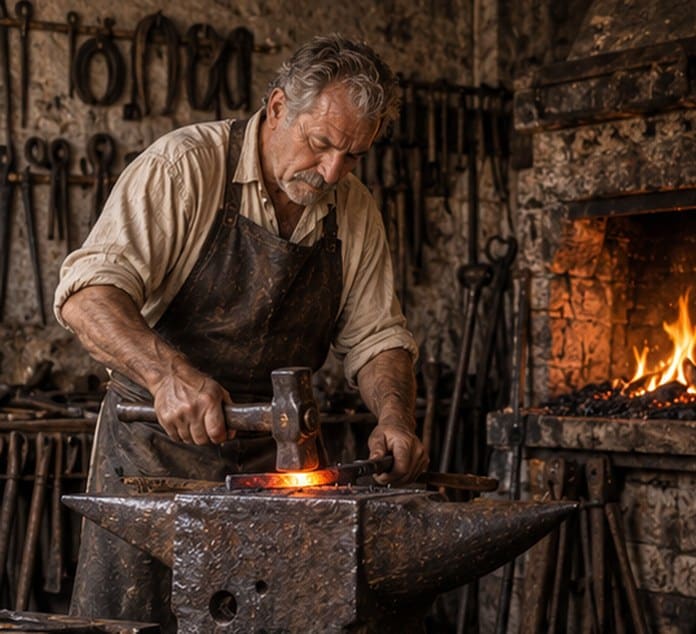
Before factories supplied every metal object imaginable, a skilled smith was needed for agricultural tools, hinges, gates, iron fittings, repairs and countless other jobs. Blacksmiths are also specifically recorded among the trades operating in Corfu during the 19th century. The sound of hammer striking hot metal would once have been a familiar sound in working neighbourhoods and larger villages.
Potters and the Clay Objects of Everyday Corfu
Pottery has an ancient history on the island, but clay objects remained an important part of everyday life until relatively recent times. Historical records describe a pottery operation in Garitsa during the early 19th century with nine kilns and several workers employed at each kiln.
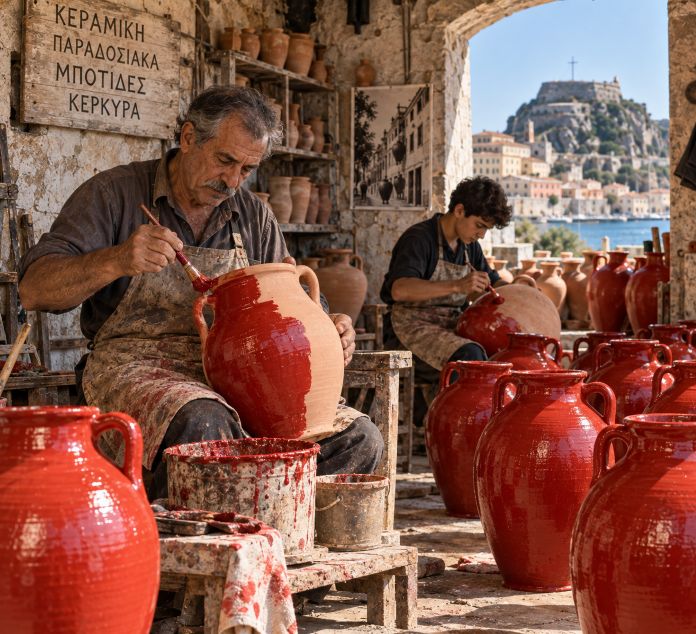
It reportedly produced tens of thousands of pieces in a year. Long before plastic containers became universal, clay was used to make jugs, containers and other useful domestic objects.
The most spectacular surviving connection between Corfu and pottery can still be seen every Easter.
On Holy Saturday morning, enormous clay pots known as Botides are thrown from balconies in Corfu Old Town and smash onto the streets during the famous First Resurrection celebration.
You can discover more about this unique tradition in our complete guide to Easter in Corfu.
The Pramatsoulides: Mobile Shops Before Mobile Shops Existed
Another colourful figure in old village life was the travelling merchant, remembered locally as the pramatsoulis.
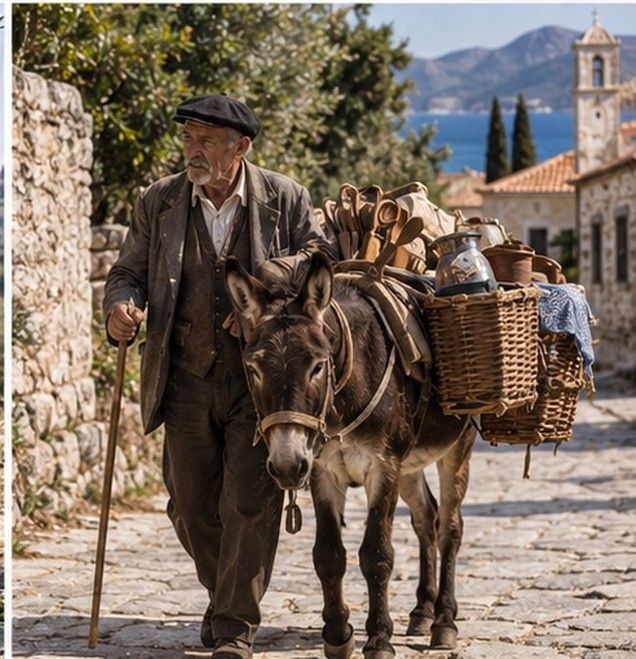
Imagine living in a small Corfiot village when travelling to Corfu Town could take hours.
The merchant came to you. Pramatsoulides moved from village to village carrying goods for sale, originally often using donkeys and later bicycles and other forms of transport.
For isolated communities, their arrival was effectively a small travelling shop.
But these men carried something else as well. News.
Someone regularly travelling between villages heard stories, knew what was happening elsewhere and inevitably became part of the informal communication network of the island.
The traditional Corfiot sled, known as lissa.
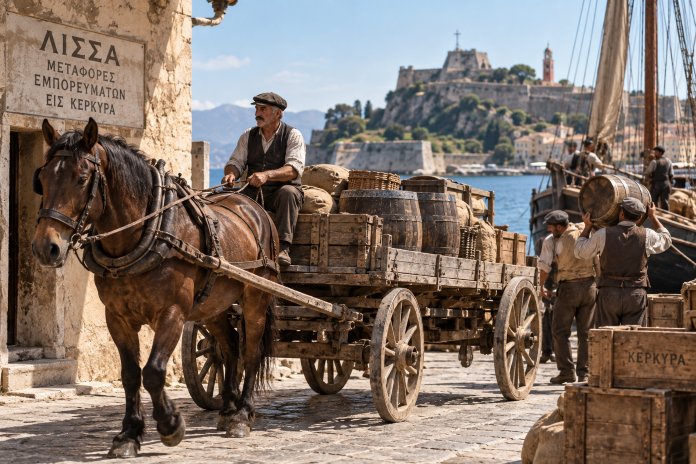
This is one of the most interesting old Corfiot forms of transport I found while researching this article.
Historical descriptions of Corfu remember the lissa as a long wooden four-wheeled vehicle with an open rectangular loading platform, normally pulled by a horse. One oral description remembers it as being around three to four metres long.
In practical terms, you could think of it as one of the delivery trucks of its era.
Almost anything could be loaded onto one. Historical accounts specifically mention lisses carrying barrels of wine from warehouses to neighbourhood tavernas in Corfu Town.
During the difficult years of the Second World War they were still being used to transport food, household possessions and other goods around the island. The person operating such a vehicle was part driver, part transporter and part delivery service.
Then engines arrived, trucks became common and the lissa slowly disappeared from Corfu’s roads.
Horse-Drawn Carriages: The Taxis of Their Time
For passengers, horse-drawn carriages performed something much closer to the role of the modern taxi.
Until well into the early decades of the 20th century, travel between Corfu Town and the villages was still carried out using horse-drawn carriages. Historical accounts describe stables on the outskirts of Corfu Town where horses and carriages arriving from villages were kept. These places effectively became arrival and departure points for passengers.
Today we complain if a taxi takes twenty minutes to arrive.
For a villager travelling to town a century ago, the journey was a completely different expedition.
Saddle Makers and Harness Makers
When horses, donkeys and mules were essential forms of transport, another group of craftsmen became indispensable.
The saddle maker produced and repaired saddles for working animals.
Harness makers produced the straps, bridles and other equipment needed to connect an animal safely to a cart or carriage.
A damaged harness could stop a family’s transport system in exactly the same way that a mechanical breakdown can stop a van today.
Farriers: The Mechanics of the Horse Era
The farrier, or petalotis, was another essential specialist. Working animals needed their hooves maintained and protected with horseshoes.
As long as Corfu depended heavily on horses, mules and donkeys for farming and transport, somebody had to keep those animals able to work.
When motor vehicles replaced working animals, professions such as saddle making and horseshoeing inevitably declined with them.
The Village Midwife: The Woman Called When a Baby Was Coming
Perhaps no old village role carried more responsibility than that of the traditional midwife.
Before modern maternity wards, ambulances and easy transport to hospital, most women in rural communities gave birth at home. When labour began, the woman everyone wanted to find was the mama or village midwife.
Some were formally trained, particularly in later years, but earlier village communities also relied heavily on experienced practical midwives whose knowledge had been acquired from assisting at many births.
They advised pregnant women, attended labour and helped both mother and newborn during the first critical hours.
In isolated villages this could mean travelling at any time of the day or night, sometimes over poor roads and in difficult weather.
The village midwife occupied a remarkable position of trust.
She might eventually have helped bring several generations from the same families into the world.
Corfiot folklore surrounding childbirth also shows how different that world was. Birth took place within the home and was surrounded not only by practical knowledge but also by traditions, beliefs and superstitions handed down through generations.
The Mpouloukia of Women Who Followed the Olive Harvest
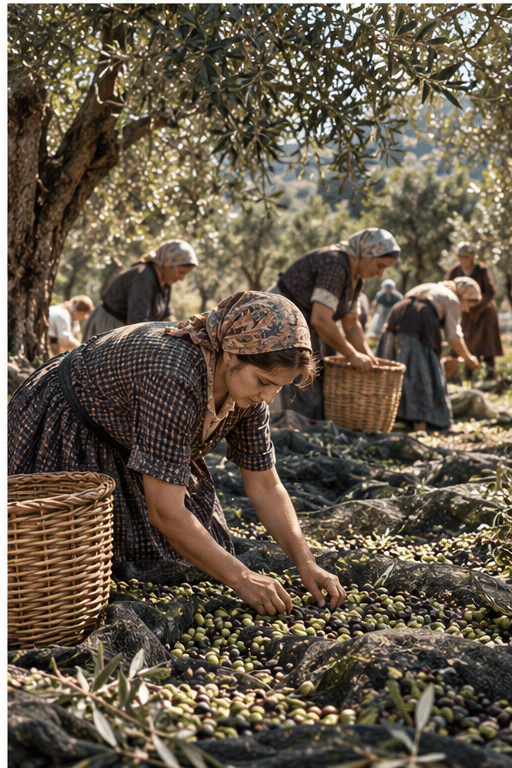
Few activities shaped rural Corfu as deeply as the olive harvest.
For generations, olive oil was one of the foundations of the island’s economy and harvesting demanded enormous amounts of manual labour. Groups of women travelled to estates and neighbouring villages wherever workers were required.
These groups were sometimes remembered as mpouloukia.
They could leave home extremely early and spend long winter hours beneath enormous olive trees collecting fruit from the ground and filling baskets. For poorer families, seasonal olive work provided important income.
Today old photographs of women working beneath Corfu’s giant olive trees can look romantic. The reality was very different.
It was exhausting physical work, frequently performed on wet ground during the coldest and dampest months of the Corfiot year.
Oil-Mill Workers
Collecting the olives was only the beginning.
Corfu once contained a huge number of traditional olive presses scattered throughout the countryside.
The fruit was crushed under enormous circular stones, historically often turned with animal power, before the paste was pressed to separate the oil.
The mill and its workers therefore occupied a central place in village life during the harvest season.
When olives started arriving, the mill could become one of the busiest places in the entire community.
Modern machinery has made the process quicker, cleaner and far more efficient, but it has also removed much of the distinctive world that surrounded the traditional village olive press.
The Prino-Kokki Collectors: Gathering Corfu’s Red Gold
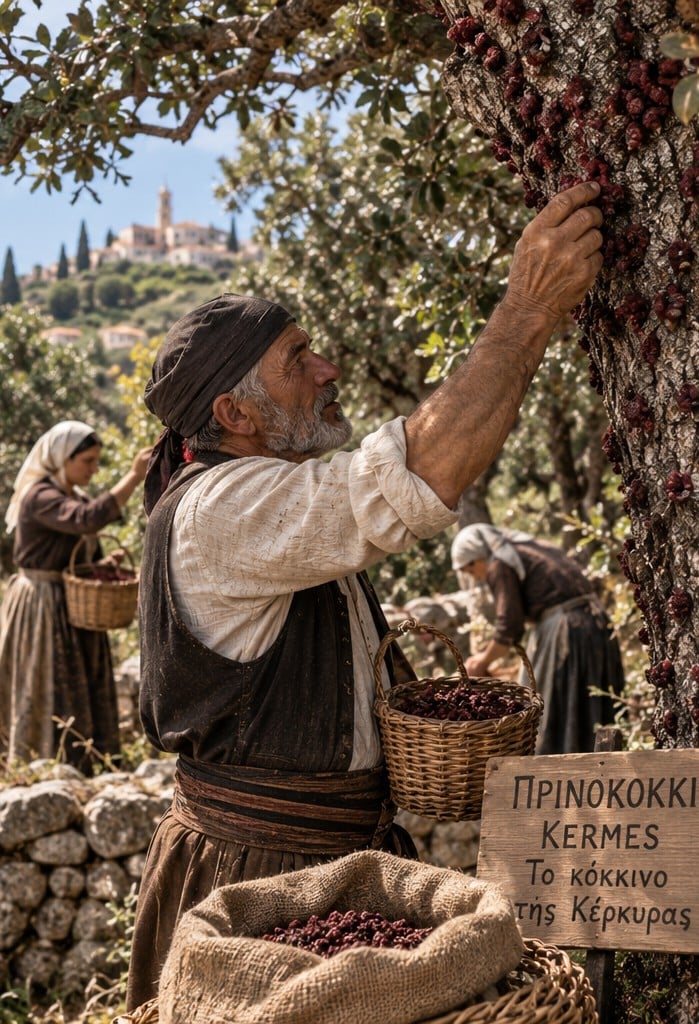
This may be one of the strangest forgotten activities in Corfu’s history.
In the countryside around places such as Giannades, people once collected what was known locally as prino-kokki.
Despite its appearance and the way it was often described as a crop, the valuable material was connected to tiny kermes insects living on certain oak trees.
The material produced an intense red dye. And this was not a minor curiosity.
A traveller who visited Corfu in 1494 described the dye-producing material as one of the island’s principal products and noted that poor villagers collected it in large quantities.
The collected material was treated, traditionally using liquids such as vinegar or wine, and dried in the sun.
It could then produce a rich red pigment used for colouring textiles such as wool and silk.
Before modern synthetic dyes, strong permanent colours were valuable commodities.
What looks today like an insignificant part of the natural landscape could therefore provide seasonal income to rural families.
The tradition is particularly fascinating because almost nobody looking at the countryside around Giannades today would imagine that people once searched the vegetation for material destined to colour expensive textiles.
Olive-Wood Carvers
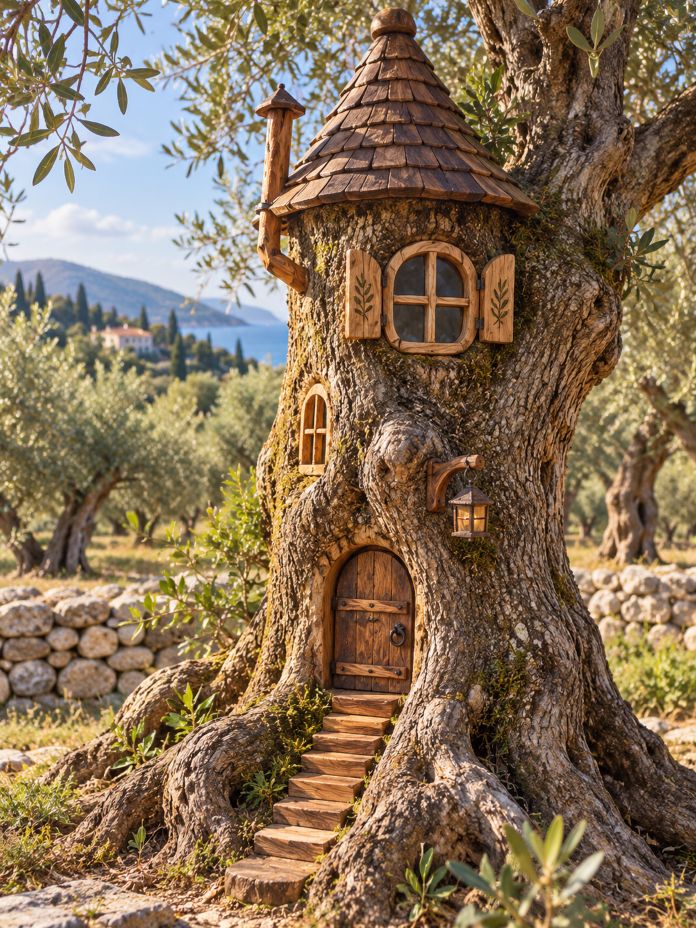
If one material represents rural Corfu, it is probably olive wood.
Centuries of olive cultivation gave craftsmen access to one of the Mediterranean’s hardest and most distinctive woods.
Village craftsmen transformed it into bowls, spoons, handles, agricultural implements, decorative objects and sometimes religious pieces. The wood’s twisting grain meant that no two objects looked exactly alike.
Unlike many vanished trades in this article, olive-wood craftsmanship has survived and modern Corfu still has artisans producing objects from local olive wood.
Basket Makers
Another material that cost almost nothing was growing naturally in wet areas, beside streams and in the countryside.
Reeds, rushes, willow branches and other flexible plants could be transformed into dozens of useful objects.
Basket makers worked the material while it remained flexible, weaving large baskets for olives, grapes, figs and vegetables as well as smaller baskets for domestic use.
Before plastic crates and shopping bags existed, these were not decorative souvenirs. They were working equipment.
Chair Makers and Reed Seats
The same skills were used to repair the traditional wooden chairs found in homes, tavernas and village coffee shops.
The wooden frame might survive for decades while the woven seat eventually wore out. A craftsman could simply weave another one. Again, there was no reason to replace the entire chair.
You repaired the part that had failed.
Mats, Cheese Baskets and Natural Rope
Reeds and rushes had many more uses.
They could become floor mats and household coverings.
Small woven baskets could be used to drain fresh cheese, with the weave leaving its characteristic pattern on the finished product.
Fresh flexible rushes could even be used as natural ties for vines, tomato plants and bundles of crops because they were strong but soft enough not to damage the plants.
The countryside effectively provided its own packaging materials.
Traditional Fishing-Trap Makers
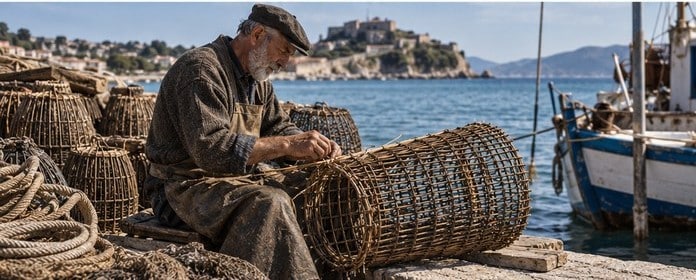
Coastal communities adapted similar weaving techniques to fishing.
Basket-like traps known as kiourtoi could be made from natural materials and placed in the sea to catch fish and other marine life. The same basic skill that produced a basket for olives could therefore produce working fishing equipment.
This flexibility was typical of traditional craftsmanship.
Barrel Makers
Before bottles, plastic containers and stainless-steel tanks became normal, wooden barrels were essential.
Wine, agricultural products and other liquids needed strong containers that could withstand years of use.
The barrel maker had to shape individual wooden staves so precisely that they created a watertight container when bound together.
In an island with vineyards, tavernas and a long wine tradition, barrels were serious working equipment rather than decoration.
The fact that old Corfiot lisses are specifically remembered transporting wine barrels around Corfu Town shows just how much these different professions depended on one another.
Tanners of Mantouki
Leather production was once another significant industry around Corfu Town.
Historical records from around 1812 describe approximately ten tanning workshops operating in Mantouki, each employing several workers. Animal hides were processed using salt, lime and oak-derived material.
The work was dirty, physically demanding and unpleasant enough that tanneries were located away from the more prestigious centre of town.
The resulting leather was then used for footwear and other products.
Better-quality material supplied shoes for wealthier customers, while lower grades were used for cheaper footwear worn by poorer people and villagers.
It was an entire local production chain: animal, tanner, leather worker and cobbler.
Workers in the Salt Pans
Salt created another profession that has almost vanished from Corfu. Historical documents record workers employed in the island’s salt pans. For centuries salt was far more important than something sprinkled over food.
Before refrigeration, it was one of the essential tools for preserving food. Corfu’s salt-producing areas therefore had genuine economic value.
The old Venetian salt warehouses around Lefkimmi remain a physical reminder of this forgotten industry.
Boatmen and Port Workers
Corfu was not only an agricultural island.
Its economy also faced the sea. Boatmen moved people and goods, fishermen supplied neighbourhoods and markets, and port workers loaded and unloaded cargo by hand.
Historical records from the early 20th century include boatmen and dockworkers among Corfu’s organised workforce.
Before cranes, container ships and modern port infrastructure, moving cargo could mean dozens of men physically transferring sacks, barrels, crates and other goods between vessel and shore.
Fishermen of Mantouki and Garitsa
Mantouki in particular was historically associated with fishermen and poorer working families.
Garitsa also had substantial working boats capable of carrying grain and other goods.
The picturesque fishing boat that visitors photograph today was once a workplace.
The sea was not scenery. It was income.
The Village Photographer
This is one of the professions I remember personally.
Today we probably take more photographs during one holiday than an entire Corfiot family might once have taken in years.
Back then, the photographer was somebody important.
A single photographer could serve several villages.
People needed him for weddings, baptisms, family portraits and official photographs for documents or school identity cards.
When I was a child and needed a photograph for my school identity card, the photographer I remember was the well-known Margaritis from Rachtades.
There were no smartphones and no taking twenty photographs until you finally found one you liked.
Having your photograph taken was an event. Those village photographers also became historians without necessarily intending to. The images they left behind preserve faces, clothes, houses, weddings, schoolchildren and ordinary moments from a Corfu that no longer exists.
The Ravdoskopos: Searching for Water Beneath the Ground
Water was precious, especially in rural communities before modern networks reached every house and field.
This created another unusual figure in village life: the ravdoskopos, or water dowser.
Dowsers claimed to locate underground water by walking across land with a forked branch, rod or similar object.
A farmer or landowner considering where to dig an expensive well might call a person who had developed a local reputation for finding water. Dowsing is a traditional belief and is not considered a scientifically reliable method of detecting groundwater.
But in old villages, reputation and experience mattered enormously.
A man who seemed repeatedly to choose successful locations could become known across several communities.
Embroiderers, Lacemakers and the Women’s Work That Became Art
Some of the most skilled craftsmanship in old Corfu never happened inside a professional workshop.
It happened inside the home. Women learned embroidery, crochet, weaving and lace-making, frequently producing items destined for a daughter’s dowry.
Sheets, tablecloths, clothes and decorative fabrics could represent hundreds of hours of painstaking work.
Corfu’s centuries of contact with Venice also influenced local decorative tastes.
Traditional Corfiot costumes display some of this extraordinary craftsmanship in their embroidered details and fabrics.
Because this was usually women’s domestic work, it was often regarded simply as another household duty rather than an artistic profession.
Looking at surviving examples today, that description seems very unfair.
Goldsmiths and Silversmiths
At the other end of the craft spectrum were the island’s goldsmiths and silversmiths.
Corfu’s urban economy supported workshops producing jewellery, religious objects and decorative pieces.
Historical records show that metalwork and jewellery-making formed part of Corfu’s artisan economy over several periods.
Many religious objects seen today in old churches also remind us of the extraordinary level of workmanship these craftsmen could achieve without modern machinery.
Millers
Grain also created its own indispensable profession.
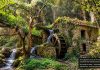
Before bags of flour arrived from industrial mills, grain had to be ground locally.
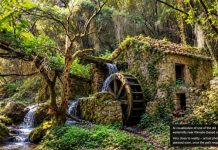
Watermills and other mills were therefore vital pieces of rural infrastructure.
A village could grow its grain, but without the miller there was no flour and without flour there was no bread.
Like the olive press, the mill was one of those places where agriculture and specialised craftsmanship met.
Children Made Their Own Toys
Even children’s entertainment could begin with whatever grew nearby.
Reeds and other natural materials became little animals, figures and simple boats that children floated on streams, ponds or village water channels.
No toy shop was required.
No batteries were required either.
Perhaps the toy survived for only a few days.
That did not matter.
Another could be made.
A World Where Almost Nothing Was Wasted
What strikes me most when researching these professions is not simply how many different jobs existed.
It is how different people’s relationship with possessions was.
A damaged shoe went to the cobbler.
A copper pot went to the tinsmith.
A torn jacket went to the tailor.
A broken chair was rewoven.
An old wooden door was repaired by the carpenter.
Olive wood became a spoon or agricultural tool.
Reeds became baskets, chairs and mats.
An animal provided transport, while another craftsman made its saddle and another fitted its horseshoes.
The woman who needed to give birth relied on the village midwife.
The farmer who needed a well might ask the dowser where to dig.
The family that needed goods waited for the travelling merchant.
And if something heavy needed to travel to town, somebody arrived with a lissa, cart or horse.
What Still Survives in Corfu Today?
Thankfully, not everything has vanished.
Traditional soap is still made.
Olive-wood craftsmen continue to work.
Embroidery survives in families and cultural associations.
Traditional olive presses, rural museums, old workshops and village houses preserve pieces of the agricultural world.
And every Holy Saturday thousands of people still watch Corfu’s clay Botides fall from balconies and explode onto the streets.
But the society that created these professions has changed beyond recognition.
The travelling tinsmith no longer announces his arrival through the village.
The pramatsoulis does not arrive carrying merchandise on his donkey.
The lissa has been replaced by the truck.
Women no longer need to walk to another village to find seasonal olive work in the same way.
We do not wait for a photographer from another village to arrive so that we can obtain one precious photograph.
And when a baby is coming, nobody runs through the village looking for the local mama.
Corfu Did Not Begin With Tourism
For visitors, I think these stories reveal something important about the island.
Corfu did not begin with hotels, swimming pools, beach bars and package holidays.
Behind today’s tourist island was an agricultural, maritime and artisan society that survived for centuries through local knowledge, difficult physical work and an extraordinary ability to use whatever was available.
When you explore Corfu and its villages, look beyond the stone houses and narrow lanes.
Imagine the tailor measuring a customer inside a tiny workshop.
Imagine the tinsmith repairing a copper pot.
Imagine a carpenter making shutters by hand.
Imagine women leaving before sunrise to collect olives.
Imagine a horse pulling a heavily loaded lissa toward Corfu Town.
Imagine a village midwife being woken in the middle of the night because a baby was coming.
Imagine poor villagers around Giannades searching the vegetation for the tiny material that produced valuable red dye.
Imagine a travelling merchant arriving with goods and news from another village.
And imagine a photographer setting up his tripod while everybody stood completely still because that one photograph might have to last for years.
That was also Corfu.
Perhaps, in many ways, it was the most authentic Corfu of all.
Do you remember another old Corfiot profession, craftsman or village character that I have missed?
I would especially like to hear memories from older Corfiots and from families whose parents or grandparents practised one of these professions. Every small story can help preserve another piece of the island’s history before it disappears.
And if you enjoy discovering the Corfu that exists beyond the beaches and tourist brochures, subscribe to the EnjoyCorfu newsletter for new local stories, hidden places and island discoveries.
Discover the Best of Corfu!
Get local events, travel tips and important Corfu updates delivered straight to your inbox.